


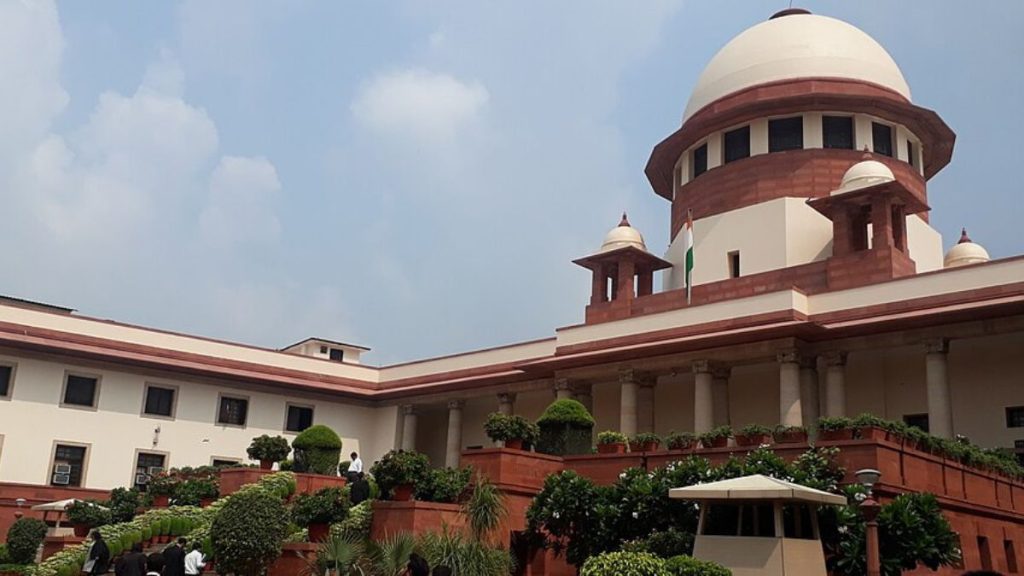
New Delhi: The Supreme Court has rejected a final legal challenge by a former short-service commissioned officer seeking proportionate pension benefits, dealing a setback to military veterans who have long demanded retirement pensions for service periods shorter than those prescribed under existing rules. The decision leaves the prevailing pension framework undisturbed and brings to an end a prolonged legal battle over whether officers released after completing their short-service tenures can claim pensionary benefits proportionate to their years in uniform.
A five-judge bench headed by the chief justice of India, Surya Kant, dismissed a curative petition filed by Major R Varadaraja Bharath (retired), a former Army Dental Corps officer who had served for 10 years and one month. In its October 28 order, which was reported by Tribune on Friday, the court held that the petition failed to satisfy the exceptional legal requirements for reopening a matter already decided by the country’s highest judicial authority.
The bench, also comprising Justices Vikram Nath, BV Nagarathna, Manoj Misra and Manmohan, declined Bharath’s request for an oral hearing before dismissing the petition through circulation. The judges relied on the principles established in the Supreme Court’s landmark 2002 ruling in Rupa Ashok Hurra versus Ashok Hurra, which defined the narrow circumstances under which a final judgment could be reconsidered.
Unlike an ordinary appeal, a curative petition is an extraordinary judicial remedy available after a review petition has failed, primarily to prevent a serious miscarriage of justice or abuse of judicial process. Its dismissal effectively exhausts the petitioner’s remedies within the Supreme Court, although it does not prevent the government from independently reconsidering the pension policy.
Long-running dispute over pension eligibility
The latest ruling follows a series of unsuccessful proceedings before the Armed Forces Tribunal (AFT) and the Supreme Court, beginning with the tribunal’s rejection of Bharath’s original application in August 2025. The AFT maintained that it could not direct the government to formulate a pension policy, treating the relief sought as falling outside its jurisdiction.
The Supreme Court subsequently declined to interfere with the tribunal’s decision, and a review petition was dismissed in April 2026 before Bharath approached the court again in May. His case also reflected a wider grievance among former short-service officers who contend that their military service should qualify them for a proportionate pension even when they cannot complete the normal qualifying period.
Under the existing system, short-service commissioned officers generally serve for an initial 10 years, with provision for an extension of four years, and may be considered for permanent commission depending on eligibility and selection. Officers released after completing their short-service engagement ordinarily do not qualify for a regular retiring pension, although applicable rules provide for terminal benefits and certain exceptions.
According to the Ministry of Defence’s pension guidelines, commissioned officers generally require 20 years of qualifying service to receive a regular pension, compared with 15 years for personnel below officer rank. The pension regulations nevertheless contain separate provisions for specific categories, making the nature of an officer’s commission, service history and circumstances of release important in determining entitlement.
Veterans challenge decades-old Army instruction
At the centre of Bharath’s argument was Army Instruction 11/S of 1964, which left pensionary terms for certain short-service officers under consideration, with further orders to be issued separately. His legal representatives argued that this administrative provision could not override the Pension Regulations of 1961, particularly provisions dealing with pension or gratuity in specified circumstances.
Lieutenant Colonel GPS Virk (retired), a Chandigarh-based lawyer who represented the petitioner before the tribunal, maintained that Rule 30 of the 1961 regulations provided a legal basis for considering pension claims involving shorter periods of service. The petitioners consequently challenged the treatment of their demand as a question requiring fresh government policy rather than an entitlement arising from existing pension regulations.
Importantly, the October 28 order did not deliver a detailed ruling on the interpretation of the disputed pension regulations or independently determine whether proportionate pension should be available to all short-service officers. It dismissed the curative petition on the narrower ground that the case did not meet the stringent requirements for reopening a concluded Supreme Court proceeding.
The wider legal position also includes separate Supreme Court decisions granting pensionary relief to particular categories of women short-service officers affected by discriminatory permanent-commission selection practices. Such judgments, including a March 24 ruling concerning Indian Air Force officers, involved distinct circumstances and do not establish a general entitlement to proportionate pension for all short-service personnel.
For former short-service officers seeking pension reform, the latest decision means that the broader demand remains unresolved at the policy level. Any general extension of proportionate pensions to officers released before completing the prescribed qualifying service would now require a change in government policy or another legally sustainable basis for relief.