


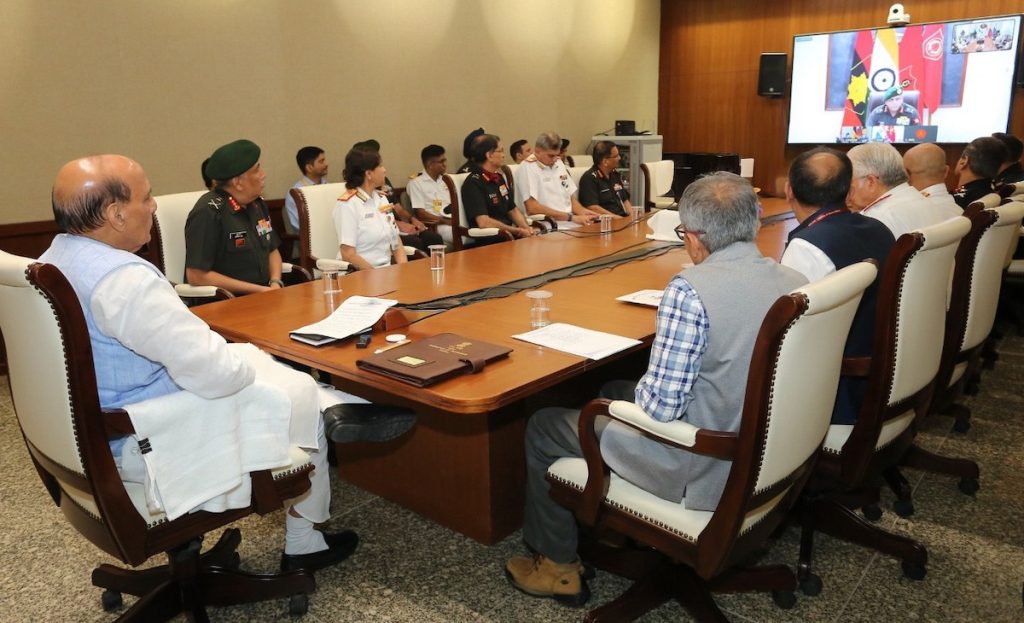
New Delhi: The defence minister, Rajnath Singh, virtually inaugurated the Department of Military Medicine at Command Hospital (Central Command) in Lucknow on Wednesday. This now establishes the country’s first academic and operational department devoted exclusively to the discipline.
Set up under the Directorate General of Medical Services (Army), the department is intended to sharpen combat medical readiness, build indigenous doctrine and train specialists for both battlefield and disaster-relief roles. Singh said the move strengthens the operational preparedness of the Armed Forces Medical Services (AFMS), the triservice body that runs military healthcare.
Eight disciplines, phased rollout
The department will cover eight areas: military trauma and damage control; combat psychiatry and resilience; environmental and operational medicine; military medical logistics; chemical, biological, radiological, nuclear and explosive (CBRNe) medical response; emergency medicine and critical care; disaster medicine; and humanitarian assistance and disaster relief (HADR), alongside research, audit and data analytics. It will also work on battlefield technology such as simulation-based training, telemedicine and prolonged field care.
Officials said the rollout will happen in three stages – setting up academic programmes first, followed by dedicated centres of excellence in CBRNe and disaster-relief medicine, and eventually a nationally and internationally recognized centre for military medicine.
Singh drew a comparison with aerospace medicine, which addresses the physiological demands on pilots and astronauts, arguing that military medicine similarly needs to study how war conditions affect the human body. He said Indian troops serve across some of the world’s harshest terrains and climates, and the department would develop protocols suited to those environments.
Preventive healthcare ‘first line of defence’
Singh also pressed for preventive healthcare to be treated as a frontline security matter rather than an afterthought to treatment. He called for a system built on disease surveillance, vaccination, sanitation, nutrition, fitness and regular screening, backed by artificial intelligence, wearable devices and predictive analytics to flag health risks among soldiers early.
He described the new department as a marker of a broader shift in military thinking, and said the goal was to build “the world’s best battlefield medicine research centre.”
The event was attended by the chief of the Army staff, General Dhiraj Seth; the defence secretary, Rajesh Kumar Singh; the vice-chief of the Army staff, Lieutenant General Sandeep Jain; the general officer commanding in chief (GOC-in-C) of Central Command, Lieutenant General Anindya Sengupta; the director general of the AFMS, Surgeon Vice Admiral Arti Sarin; the adjutant general, Lieutenant General VPS Kaushik; the director general of medical services (Army), Lieutenant General CG Muralidharan; the additional secretary in the department of defence, Manish Tripathi; and the commandant of Command Hospital (Central Command), Major General Alok Bhalla, among other senior officials.
A global precedent
India is not the first country to formalize military medicine as a distinct academic discipline. The United States has run a comparable model since 1972 through its Uniformed Services University in Bethesda, Maryland, the only American medical school with a dedicated department of military and emergency medicine, training active-duty physicians alongside their medical degrees. India’s version differs in structure – it is built atop an existing tri-service hospital network rather than a standalone university – but points in a similar direction: treating combat medicine as a specialization in its own right rather than a subset of general practice.
The defence ministry has also linked the Lucknow department to a proposed Global Military Medicine Centre under the Raksha Strategy Vision 2026-30, suggesting the current launch is an early step rather than the finished product. Given India’s long-standing role in United Nations peacekeeping and disaster-relief deployments abroad, officials are positioning the new department’s expertise in mass-casualty management and epidemic control as relevant well beyond India’s own borders – though how quickly that ambition translates into operational capacity will depend on staffing, funding and the pace of the phased build-out over the coming years.