


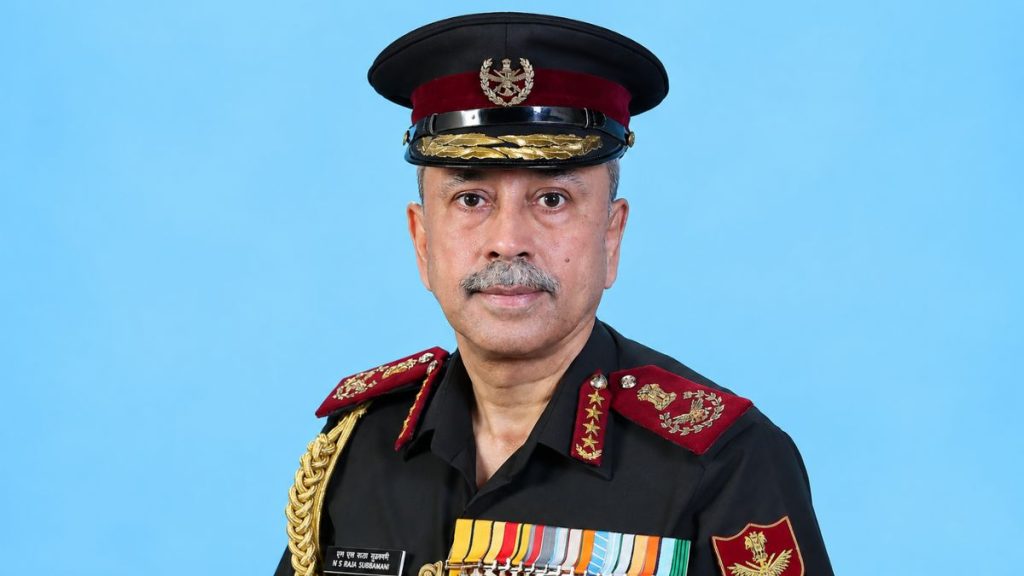
New Delhi: The chief of defence staff, General NS Raja Subramani, has warned that Pakistan’s space capabilities are improving with Chinese assistance and must be considered in India’s military planning. He said New Delhi should strengthen satellite surveillance and supporting systems as space-based intelligence becomes central to operations across land, sea and air.
Speaking at a seminar on future warfare and multi-domain operations in New Delhi on Friday, CDS said: “As far as your first question relating to Pakistan’s space capability, yes, its space capability is improving with Chinese help.” He added that the Pakistan space and upper atmosphere research commission (Suparco) was developing its own capabilities, while Turkiye could provide further assistance.
His remarks followed a question about Pakistani astronaut, Muhammad Zeeshan Ali, who travelled to China’s Tiangong space station aboard Shenzhou-24 on Wednesday. Ali became the first foreign national to participate in China’s crewed space programme, in a year marking 75 years of diplomatic relations between Beijing and Islamabad.
Chinese support and military implications
The CDS warned that “whatever capabilities are available with the Chinese in terms of ISR, positional navigation, timing, etc., will be available to the Pakistanis”, adding that India must “factor in into our calculus” this possibility. “Their ISR will be better,” he said, stressing that India must strengthen its own intelligence, surveillance and reconnaissance capabilities to meet evolving operational requirements.
His comments were an assessment of potential cooperation, not confirmation that Pakistan possesses China’s military satellite infrastructure. Participation in a crewed space mission does not itself establish a transfer of classified surveillance technology or military capabilities.
ISR satellites can help monitor border infrastructure, troop movements and maritime activity, while navigation and timing services support coordination and precision operations. More frequent coverage can reduce revisit time, the interval between successive observations of the same location, giving commanders more current information.
India’s response through satellite expansion
Gen Subramani said the space-based surveillance phase III (SBS-3) programme would “enhance our capabilities to a great extent” once operational. He also said India was working to build and launch more satellites with help from private-sector companies and entrepreneurs.
The Times of India reported that the Cabinet Committee on Security approved SBS-3 in October 2024, with a reported cost of ₹26,968 crore and a proposed constellation of 52 surveillance and reconnaissance satellites. Those figures concern a planned programme, not a fleet of 52 satellites already operating in orbit.
The CDS cautioned against attempting to match China’s satellite inventory one for one. “We need to have enough to look at our borders and the ability to reduce that revisit time,” he said, emphasizing coverage guided by India’s operational requirements.
Gen Subramani emphasized that integrating military and space architecture and maintaining reliable communications were essential for multi-domain operations. Warning that technological superiority is “only transitory”, he stressed the need for continuous improvements in military capabilities to remain prepared for future conflicts.