


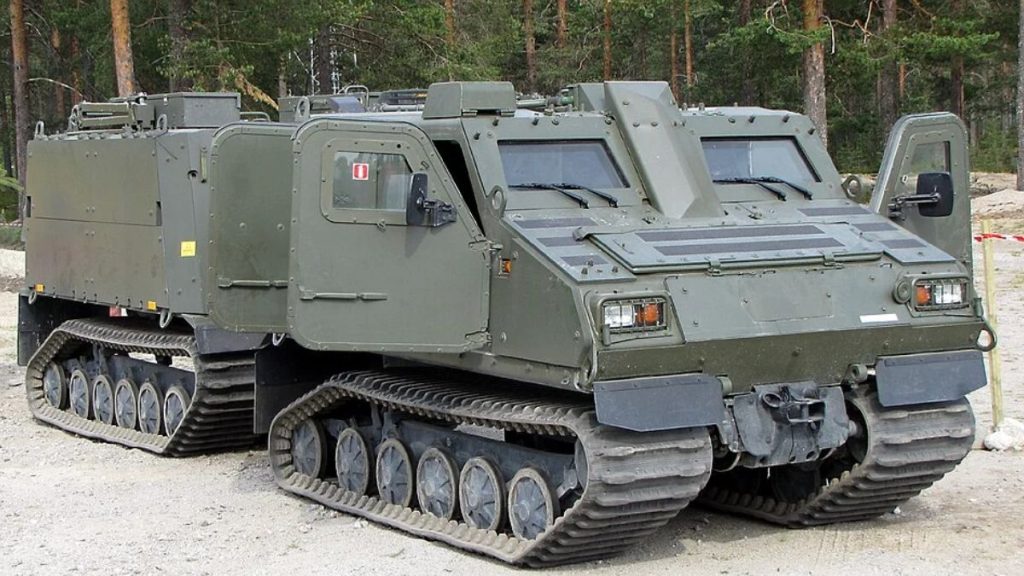
New Delhi: Larsen & Toubro (L&T) and BAE systems began production of the BvS10 Sindhu articulated all-terrain vehicle at L&T’s armoured systems complex in Hazira, Gujarat, on Wednesday. The Indian Army’s initial order of 18 vehicles is intended to improve troop mobility and logistics in Ladakh’s high-altitude terrain and Kutch’s marshlands near the Pakistan border.
According to ANI, the vehicles are expected to operate at elevations reaching 18,000 feet in Ladakh, where temperatures can fall to minus 55°C. In Kutch, where temperatures can reach 55°C, they are intended to support patrolling across marshlands, desert stretches and the Great Rann.
BvS10 Sindhu designed for difficult terrain
The BvS10 Sindhu is a tracked, articulated vehicle comprising two connected sections that flex while negotiating uneven terrain. According to BAE systems, its design enables movement across snow, ice, rocks, sand and marshland, while amphibious capabilities allow it to cross flooded areas and suitable waterways.
The modular platform supports several configurations, including troop transport, logistics, medical evacuation, command and control, and vehicle recovery. However, the specific variants included in India’s initial order have not been publicly detailed.
The India-specific BvS10 Sindhu has completed trials in high-altitude and sea-level environments, according to the manufacturers. The wider BvS10 platform is operated by several European armed forces, including those of the United Kingdom, Sweden and France.
BAE systems Hagglunds, president Tommy Gustafsson-Rask, said the vehicle had demonstrated its capabilities in conflict situations and was being used in limited numbers in Ukraine. He said the company had received positive feedback, although these claims concern the wider BvS10 platform rather than India’s newly manufactured variant.
Licenced manufacturing strengthens domestic capability
Under the manufacturing arrangement, L&T will produce the Indian variant at Hazira with technical and design support from Sweden-based BAE systems Hagglunds, the original developer. The companies announced their partnership in September 2023 before securing the Indian Army contract in November 2025.
The agreement includes integrated logistics support covering initial deployment, maintenance and lifecycle sustainment. The defence publication Janes reported that at least 60 per cent of the programme’s content must be sourced from Indian industry.
Speaking at Wednesday’s production launch, L&T executive, Arun Ramchandani, highlighted the platform’s versatility.
“From the Rann of Kutch to the heights of Leh, this is a vehicle which can serve the Indian Armed Forces,” he said.
Production commencement does not mean the vehicles have been delivered or operationally deployed.
Janes previously reported that deliveries were expected to begin within 24 months of the 2025 contract, although a firm handover date has not been publicly confirmed.
The next milestone will be the delivery of the vehicles to the Army, marking the transition from domestic manufacturing to fielding specialized mobility capabilities for India’s challenging border terrain.