


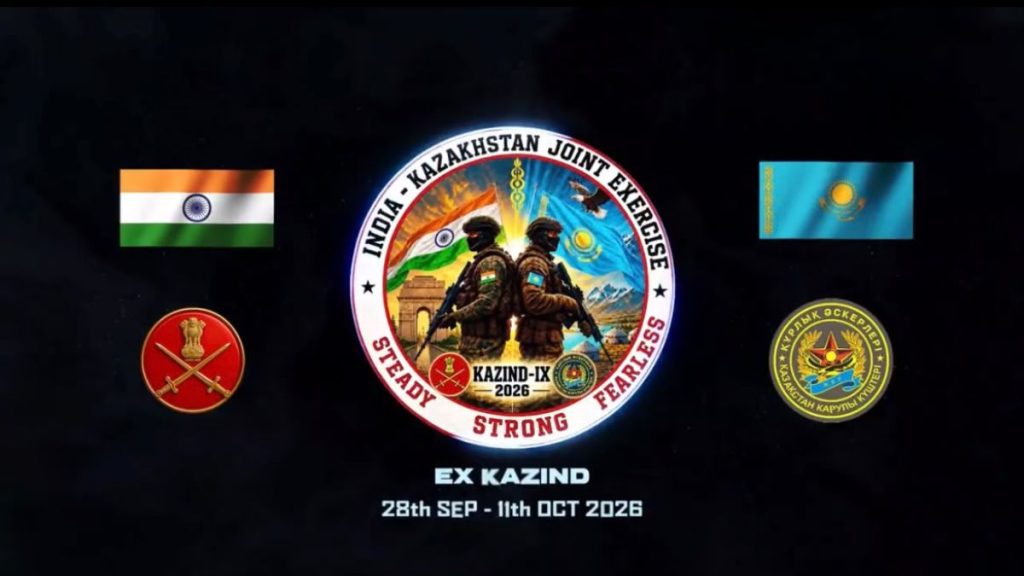
New Delhi: India and Kazakhstan are preparing for the ninth edition of their joint bilateral military exercise Kazind, extending a defence engagement that has grown from army-level tactical training into broader armed forces interaction. The exercise comes as the two countries widen cooperation across security, connectivity, energy, critical minerals and emerging technologies.
The upcoming edition has been announced, but its dates, location, participating units and troop strength are yet to be officially released. Those details will show how far Kazind 2026 builds on the exercise’s previous focus on interoperability, counter-terrorism and joint tactical procedures.
The Additional Directorate General of Public Information (ADGPI) of the Indian Army said in an X post that the “9th edition of the joint bilateral military exercise Kazind between the Indian Armed Forces & Kazakhstan Armed Forces” was “coming soon”.
From Prabal Dostyk to Kazind
The exercise began in 2016 as Prabal Dostyk and, after its second edition, was upgraded to a company-level exercise and renamed Kazind. An Indian Air Force component was added in 2023, making that edition a bi-service exercise.
The eighth edition was held at Auli, Uttarakhand, from September 30 to October 13, 2024. The 120-member Indian contingent included a battalion of the Kumaon Regiment and Indian Air Force personnel, while Kazakhstan fielded land forces and airborne assault troops.
Kazind-2024 included counter-terrorism training, joint command-post work, intelligence and surveillance, special heliborne operations, combat free fall and drones and counter-drone systems. These were previous-edition activities and are not confirmed for 2026.
Strategic engagement broadens
The Kazakhstan-India Strategic Dialogue in Astana on September 24 brought together diplomats, academics and think-tank experts to discuss regional stability, trade diversification, transport and logistics connectivity, energy, critical minerals, emerging technologies, tourism and public diplomacy. It was organised by the Indian embassy and co-organised by the Kazakhstan Institute for Strategic Studies and LN Gumilyov Eurasian National University.
Participants also examined transit costs, delivery times and financial settlement constraints affecting trade, showing that the platform extended beyond defence cooperation.
The dialogue followed talks on September 13 between the prime minister, Narendra Modi, and Kazakhstan’s president, Kassym-Jomart Tokayev, in New Delhi. They reviewed political, trade, defence and security, connectivity, energy, critical minerals, emerging technology and people-to-people cooperation.