


India’s military will have a Joint Operations Centre set up by the end of May, in a significant shift in the way its fight future wars, Chief of Defence Staff General Anil Chauhan has said.
On Monday (May 4, 2026), Chauhan announced that the Defence Space Agency would be expanded into a Defence Geospatial Agency, as part of the recommendations made regarding the creation of three theatre commands.
The CDS has already submitted the recommendations to the Ministry of Defence (MoD) in April 2026, and an announcement of the changes in the military architecture is expected anytime soon.
General Chauhan was delivering the Major General Samir Sinha Memorial Lecture at the tri-service think-tank United Services Institute (USI) in New Delhi on the topic ‘Jointness and Theaterisation: Key Challenges and Progress Made’.
The Joint Operations Centre would integrate all military action of the Army, the Navy, and the Air Force.
General Chauhan also mentioned that work was in progress to formulate a common law to cover all three-armed forces of the country, by merging the Army, Navy, and Air Force Acts.
Theatre Commands are the military formations that are geographically defined for joint operations of the Army, the Navy, and the Air Force.
A military commander of a three-star rank would head the theatre commands and would have control over the operational deployments of war-fighting assets such as aircraft, battle tanks, and warships.
General Chauhan, in his remarks, said jointness and integration of the forces were “tedious and slow” processes, as these would define theatre command structures.
“We are attempting this integration in eight verticals,” such as operations and intelligence, capability development, communications and information technology, logistics, training, maintenance, support, human resources, administration, and legal,” he said.
The three-armed forces now have a joint architecture framework that allows seamless communication.
In the operations domain, the CDS referred to the air defence system under which sensors from the three-armed forces were optimised. “We maintain air defence systems operational 24×7 along the Western Front,” he noted.
A common airspace safety organisation has also been created. All information on accidents of platforms, be it helicopters or any other, used by the three services, is shared.
Another jointness project was to integrate the equipment inventory of the three services at a cost of Rs 400 crore, he added.
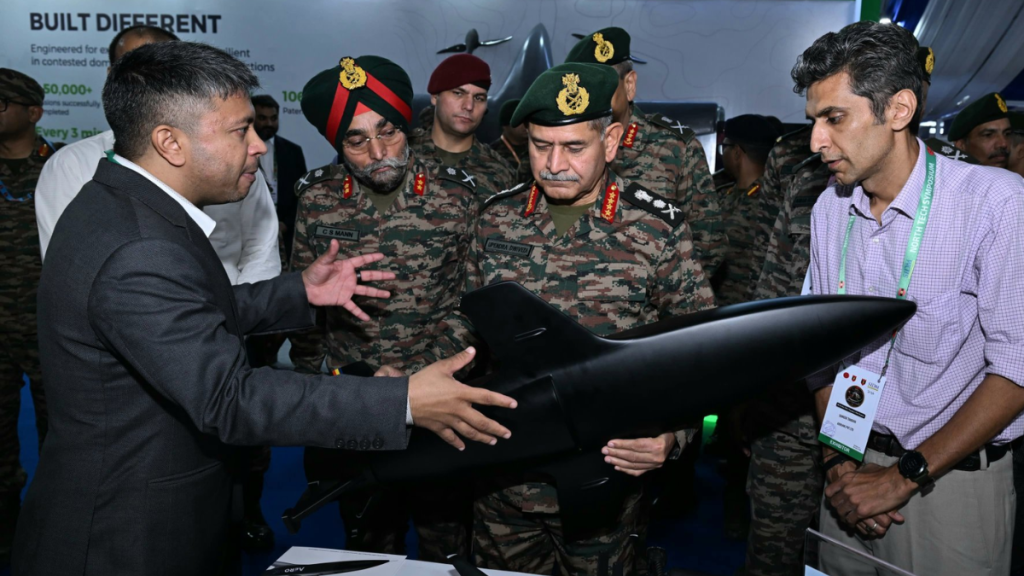
Meanwhile, at Prayagraj, Indian Army chief General Upendra Dwivedi welcomed the collaboration with the domestic defence industry, emphasising self-reliance and innovation as the cornerstone for a strong India.
At the North Tech Symposium, General Dwivedi received a briefing on a wide spectrum of indigenous defence technologies and innovation from the industry representatives participating in the exhibition.
In his remarks, the Indian Army chief commended the collaborative efforts of the army and the industry to foster self-reliance.
“The symposium underscores synergy between the armed forces, industry, and academia, aimed at enhancing operational capability, streamlining procurement, and advancing India’s self-reliant defence ecosystem,” the Indian Army quoted General Dwivedi as saying at the event.
The Indian Army posted about General Dwivedi’s visit to Prayagraj on the X social media platform.