


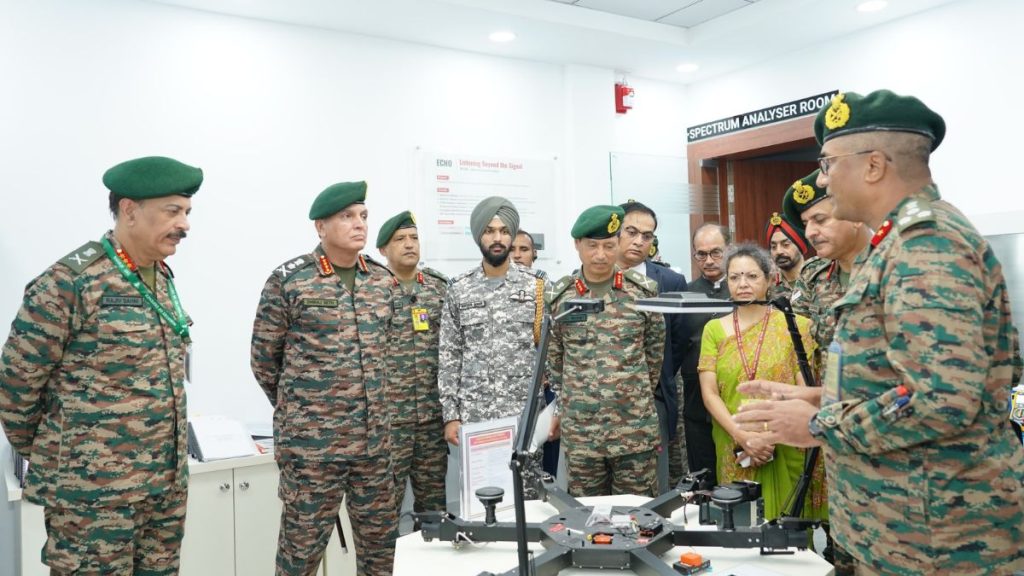
New Delhi: The Indian Army has set up a specialized laboratory to screen military drones for Chinese origin components and examine their hardware and software for potential security vulnerabilities. Called AASHVAST, or Assessment and Analysis of Electronic Systems Hardware for Vulnerabilities and Security Threats, the facility is located at the Directorate General of Electronics and Mechanical Engineering headquarters in Delhi Cantonment.
The laboratory was inaugurated on August 14 by the chief of Army staff, General Dhiraj Seth. It is intended to give the Army an in-house capability to assess the origin, integrity and security of electronic systems used in unmanned platforms before they are deployed for sensitive military tasks.
AASHVAST uses specialized software to examine electronic systems and embedded software inside unmanned platforms rather than relying only on physical inspection of components. The system scans for hidden passwords, embedded keys, remote access tools, secret command paths and altered flight limits, according to the Tribune.
The facility can also examine whether a drone accepts only manufacturer approved software updates and assess safeguards connected with GPS spoofing or jamming. Such checks are intended to identify possible weaknesses or unauthorized modifications in critical systems.
The screening does not mean that every Chinese-origin component contains malicious code, a backdoor or another security flaw. The concern is whether hardware or software of uncertain origin creates vulnerabilities that could affect the reliability or security of a military system.
Why Chinese origin components are under scrutiny
Military drones increasingly perform surveillance, reconnaissance, logistics and combat related roles, placing greater importance on the integrity of their flight controls, communications, navigation systems, sensors and embedded software.
The Army’s scrutiny focuses on both security vulnerabilities and dependence on supply chains in which the origin of critical electronics or firmware may not always be immediately apparent. An Indian company may manufacture or integrate a drone domestically while still using individual foreign-origin components or software.
The issue has been under examination for several years. In 2024, the Northern Army Command and Army Design Bureau were reported to be developing methods to identify Chinese origin components in drones and other emerging military technologies.
Armed forces developed wider screening framework
By July 2025, the three services had proposed a broader framework for screening Chinese origin hardware and software in military drones, with the mechanism intended to feed into the defence acquisition procedure review. The proposed system included disclosure of component origins, embedded software and third-party firmware, along with verification and periodic audits.
The defence ministry subsequently drafted a Framework for Testing Security Vulnerabilities in Drones this year, covering both hardware validation and software vulnerability testing. The framework identified risks including communication interception, GPS jamming and spoofing, control hijacking and data exfiltration, while listing components such as flight controllers, firmware, sensors and communication systems for scrutiny.
AASHVAST gives the Army a dedicated technical facility to conduct such assessments rather than depending solely on supplier declarations and documentation.
Push for secure indigenous drone ecosystem
The scrutiny comes as the defence ministry pushes domestic industry to reduce dependence on imported critical drone technologies. Speaking at a defence industry conclave in March, the defence minister, Rajnath Singh, said self-reliance in drones needed to extend beyond assembling complete platforms to critical components including software, engines and batteries.
Singh also noted that many drone producing countries remained dependent on Chinese components, highlighting the supply chain challenge involved in building fully indigenous unmanned systems.
For the Army, the immediate objective of AASHVAST is narrower, which is to determine whether critical hardware and software inside unmanned platforms meet required security standards and whether vulnerabilities or unauthorized components are present.