


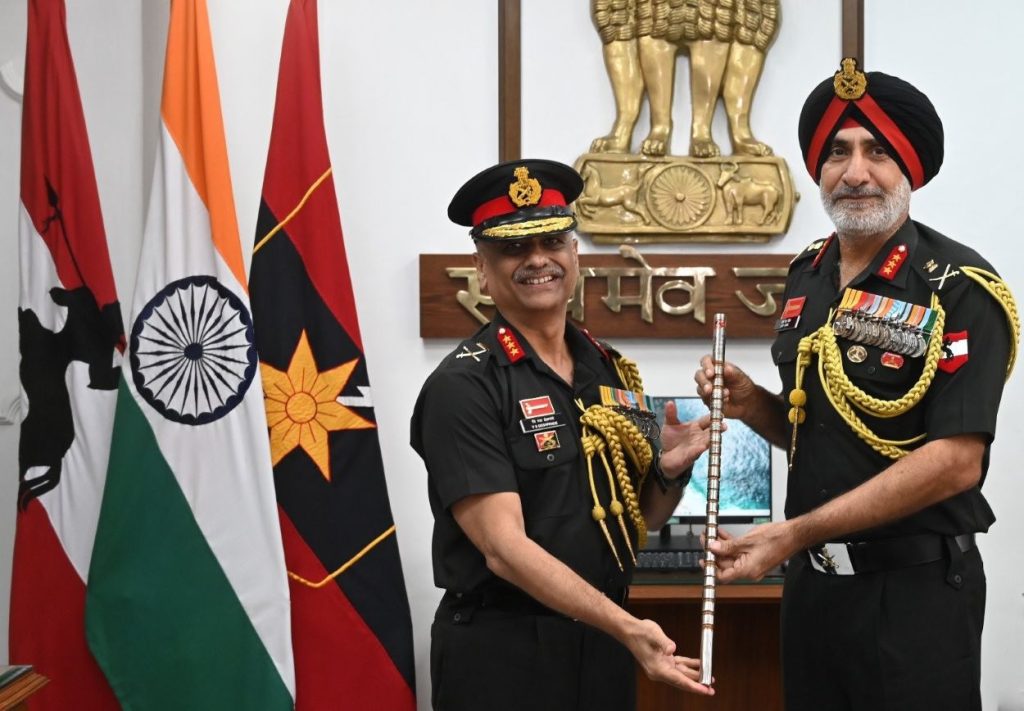
New Delhi: A round of senior military appointments took effect on Tuesday, placing new commanders at the head of two strategically important Indian Army corps and changing the leadership of key air-defence and logistics institutions. The reshuffle also extended to the Armed Forces Medical Services, where two specialists assumed senior hospital and Air Force medical appointments.
Lieutenant General Vikrant Suresh Deshpande assumed command of the X Corps (Chetak Corps) at Bathinda from Lieutenant General Shamsher Singh Virk, who had led the formation since May 2025. An infantry officer, Lt Gen Deshpande has extensive experience in counterinsurgency and counterterrorism operations in Jammu & Kashmir and the northeast, besides having commanded an infantry division along India’s northern borders.
The X Corps is responsible for the defence of southern Punjab and northern Rajasthan along India’s frontier with Pakistan, making it an important component of the Army’s preparedness on the western front. Lt Gen Deshpande urged all ranks to maintain their focus on operational effectiveness and combat readiness, while the South Western Command credited Virk with strengthening jointness and military-civil coordination during his tenure.
Lieutenant General SS Kartikeya, meanwhile, took command of the XVII Corp (Brahmastra Corps) from Lieutenant General Yash Ahlawat at Panagarh in West Bengal. Kartikeya previously commanded the Red Shield Division, formally known as the 57 Mountain Division, which is based at Leimakhong in Manipur.
The XVII Corps is the Indian Army’s only dedicated mountain strike corps and was raised to provide offensive options along the high-altitude northern frontier, particularly against China. The formation has also served as a testbed for the Army’s Integrated Battle Group concept, which seeks to create smaller, self-contained and more rapidly deployable combat formations.
Two other appointments took effect within the Corps of Army Air Defence, the specialized arm responsible for protecting field formations and critical assets against aerial threats. Lieutenant General IS Panjrath became the director general of Army Air Defence at Army Headquarters, while Lieutenant General Amit Rao took over as the commandant of the Army Air Defence College at Gopalpur in Odisha.
Lt Gen Panjrath will oversee the arm’s operational and capability-development requirements as drones, loitering munitions and precision-guided weapons reshape the air threat faced by ground forces. Lt Gen Rao, who previously served as the chief of staff of the Trishakti Corps (XXXIII Corps), will head the institution responsible for specialized tactical and technical training of Army Air Defence personnel.
Lieutenant General Sandeep Narang assumed charge as the commandant of the Military College of Materials Management in Jabalpur, succeeding Lieutenant General Sanjay Sethi, who retired on Monday. The college trains officers and personnel in military logistics, supply-chain management and related disciplines that determine how effectively formations can sustain operations over extended distances and periods.
In the Armed Forces Medical Services, Surgeon Vice Admiral Dilip Raghavan was promoted and appointed the director general of hospital services at the Directorate General of Armed Forces Medical Services in New Delhi. An alumnus of the Armed Forces Medical College, Raghavan is an ear, nose and throat specialist and neuro-otologist who has held senior clinical, academic and hospital-management appointments.
Air Marshal Vivek Hande assumed office as the director general of Medical Services (Air) on permanent secondment to the Indian Air Force. An Armed Forces Medical College alumnus and gastroenterologist, AM Hande has previously commanded the Indian Naval Hospital Ship Asvini and served as the director general of organization and personnel in the office of the director general of Armed Forces Medical Services.
Taken together, the postings are part of the military’s regular succession process rather than a structural reorganization, but they affect formations and institutions central to combat readiness and long-term modernization. Corps commanders translate operational plans into field preparedness, while the heads of training, logistics, air-defence and medical establishments shape the Army’s ability to deploy, fight and sustain forces.