


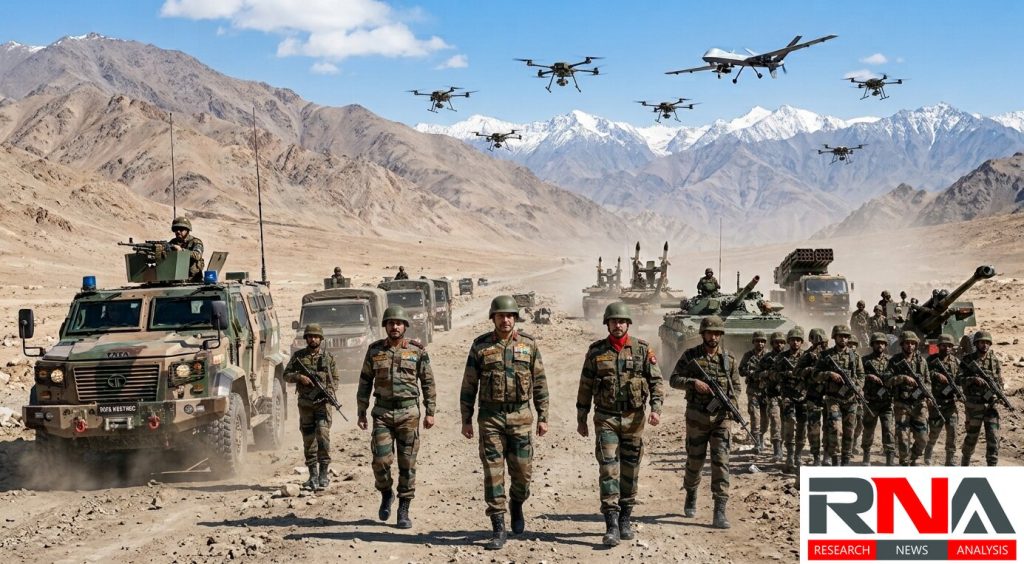
New Delhi: In one of the most far-reaching organizational reforms in its recent history, the Indian Army has operationalized its first integrated battle groups (IBGs). This is a new combat structure is designed to deliver faster mobilization, greater battlefield agility, and improved combat effectiveness along the China frontier to begin with, as RNA Media had reported in January.
The first phase of the long-awaited transformation will see six major generals assume command of five newly constituted IBGs and a dedicated fire support group (FSG). The formations have been raised under the Panagarh-based 17 Mountain Strike Corps, the Army’s only mountain strike corps and a key offensive formation tasked with operations along the line of actual control (LAC) with China in the eastern Himalayas.
The rollout marks the first operational implementation of a restructuring concept that has remained under study for nearly a decade. Originally proposed as part of the Indian Army’s wider force transformation initiatives initiated under the late General Bipin Rawat, the IBG concept aims to replace cumbersome force mobilization with compact, self-sufficient formations capable of responding to crises in significantly shorter timeframes.
Unlike conventional formations, which often assemble combat elements after hostilities begin, an IBG is conceived as a permanently organized combined-arms force. Each formation integrates infantry, mechanized forces, armour, artillery, air defence, engineers, signals, logistics, medical support and other combat enablers under a single command, allowing it to undertake independent offensive or defensive operations with minimal external reinforcement.
An IBG is expected to field around 5,000 personnel, placing it between a traditional brigade and a division in terms of size. While a brigade typically comprises around 3,000 troops and a division between 9,000 and 10,000, the new structure is intended to strike a balance between combat power and operational flexibility. Like a division, each IBG is commanded by a major general.
A notable feature of the new structure is the introduction of a chief operations officer (COO), a newly created appointment held by a brigadier within each IBG. The officer will oversee operational planning, intelligence, logistics coordination and battlefield execution, enabling the formation commander to concentrate on higher-level operational and tactical decision-making.
Alongside the five IBGs, the Army has also established a dedicated FSG, which will bring together long-range artillery, rocket systems, surveillance assets and precision-strike capabilities under a separate major general. The centralized arrangement is intended to provide concentrated firepower to multiple battle groups while improving coordination of long-range strikes across the battlefield.
The 17 Mountain Strike Corps has been selected as the pilot formation for the Army’s IBG experiment. Its existing 59 Division at Panagarh and 23 Division at Ranchi are being reorganized into the new structure. The Army intends to evaluate the operational effectiveness of the model before extending it to its remaining strike corps, including the Mathura-based I Corps, Ambala-based II Corps and Bhopal-based XXI Corps.
The reform forms part of a broader transformation programme aimed at preparing the Army for future high-intensity and multi-domain conflicts. Over the past two years, the service has also begun raising Rudra all-arms brigades, Bhairav battalions, Shaktibaan artillery regiments and Divyastra batteries, while expanding its use of drones, counter-drone systems, network-centric warfare capabilities and artificial intelligence-enabled decision support.
The modernization drive gathered momentum following the 2020 military standoff with China in eastern Ladakh, which underscored the need for faster force mobilization and greater operational integration. More recently, operational lessons drawn from Operation Sindoor have reinforced the Army’s emphasis on decentralized decision-making, precision firepower, unmanned systems and closer integration with the Navy and the Air Force.
Military planners believe the new formations will substantially reduce deployment timelines by eliminating the need to assemble combat units from dispersed peacetime locations during a crisis. Instead, the IBGs will remain permanently configured as integrated fighting formations capable of rapid employment across diverse operational environments.
For now, the initiative remains a pilot project confined to the 17 Mountain Strike Corps. Subject to its operational validation, the Army expects to complete the restructuring of the corps by mid-2027 before progressively expanding the model across its strike formations over the following years.