


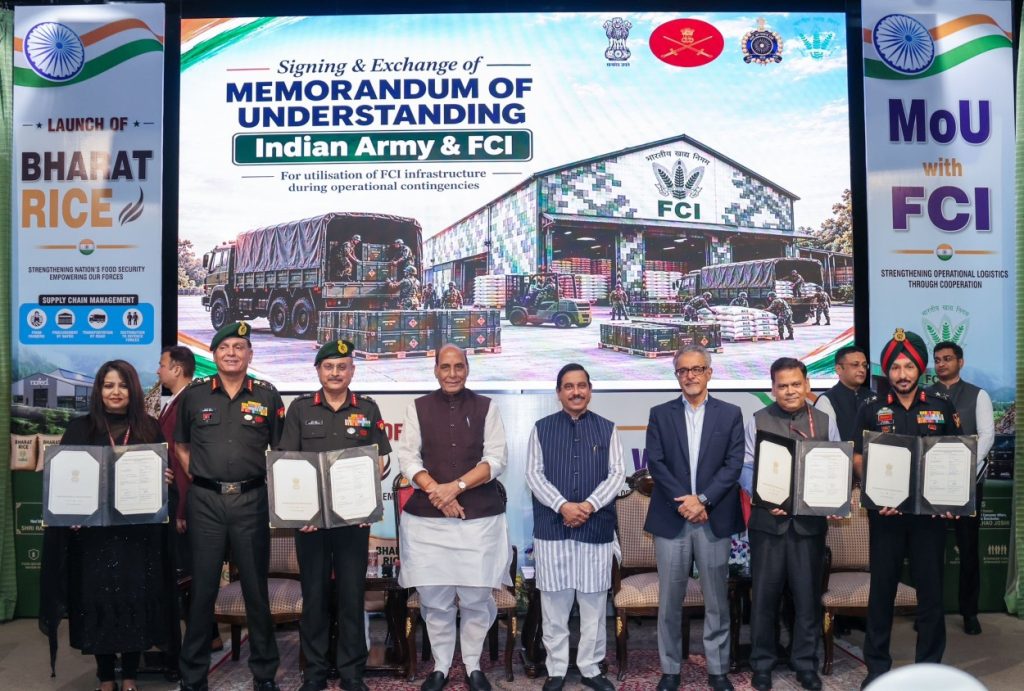
New Delhi: The Indian Army on Monday launched Bharat Rice to improve the quality and delivery of rice supplied to troops, including those deployed in Ladakh and the northeast. It also signed a five-year agreement with the Food Corporation of India (FCI), providing access to designated warehouses, labour and handling equipment during operational contingencies.
The launch and signing ceremony in New Delhi were attended by the defence minister, Rajnath Singh, and the minister of consumer affairs, food and public distribution, Pralhad Joshi. The two measures address connected requirements – improving everyday rations and ensuring that the Army can expand its logistics capacity when military operations demand additional supplies.
Under the new delivery arrangement, rice will reach Army supply depots directly, replacing the practice of depots collecting consignments from nearby FCI facilities. The change is intended to ease the collection and transportation burden on Army personnel, particularly in remote regions where moving essential supplies requires considerable planning.
The rice will be milled to defence specifications and supplied through the National Agricultural Cooperative Marketing Federation of India (Nafed) during the 2026–27 financial year. Quality checks will require it to be free of foreign matter and admixtures, while keeping broken, damaged and discoloured grains to a minimum.
Consignments will be procured in 10kg and 30kg bags to make handling and onward transportation easier, especially at forward posts. Led by the Directorate General of Supplies and Transport, the initiative follows feedback from troops and nearly 18 months of coordination involving the Army, FCI, Nafed and the department of food and public distribution.
The five-year memorandum of understanding with FCI establishes a wider framework for supporting military operations and can be extended by mutual agreement. It allows the Army to draw on identified civilian storage facilities, workers and material-handling equipment when additional logistical capacity is required.
The arrangement is intended to support faster mobilization, additional storage and the dispersal and forward positioning of rations, stores and equipment closer to operational areas. Coordination will take place between the Army’s supply and transport elements at formation level and FCI’s regional and divisional offices, with these arrangements incorporated into operational logistics plans.
Singh linked the agreement to lessons from Operation Sindoor, saying future conflicts could begin with extremely little warning and place sustained pressure on supply networks. He argued that storage, transport and timely replenishment were integral to combat capability, alongside weapons and technology.
The practical implication is that access to additional warehouses and handling resources could give military planners more options for assembling and positioning supplies before they are needed. This follows the stated purpose of the agreement: strengthening the Army’s ability to sustain operations by incorporating existing national infrastructure into its logistics arrangements.
FCI brings experience from its national food-security responsibilities, which include distributing foodgrains through the public distribution system and maintaining operational and buffer stocks. The pact extends the use of selected resources from that civilian network to military contingency planning.
Bharat Rice itself predates the Army initiative: the government launched its consumer retail programme on February 6, 2024, to make rice available at an affordable price through cooperative and other outlets. The latest announcement concerns supplies prepared to defence specifications, with packaging and delivery arrangements tailored to military requirements.
The defence ministry said the measures form part of a broader effort to improve ration quality and allowances, including additional rations for Agniveer recruits and greater commonality in ration scales across the three services. Organic rations are also proposed, while the FCI arrangement is aligned with the government’s PM Gati Shakti approach to coordinating infrastructure and logistics.