


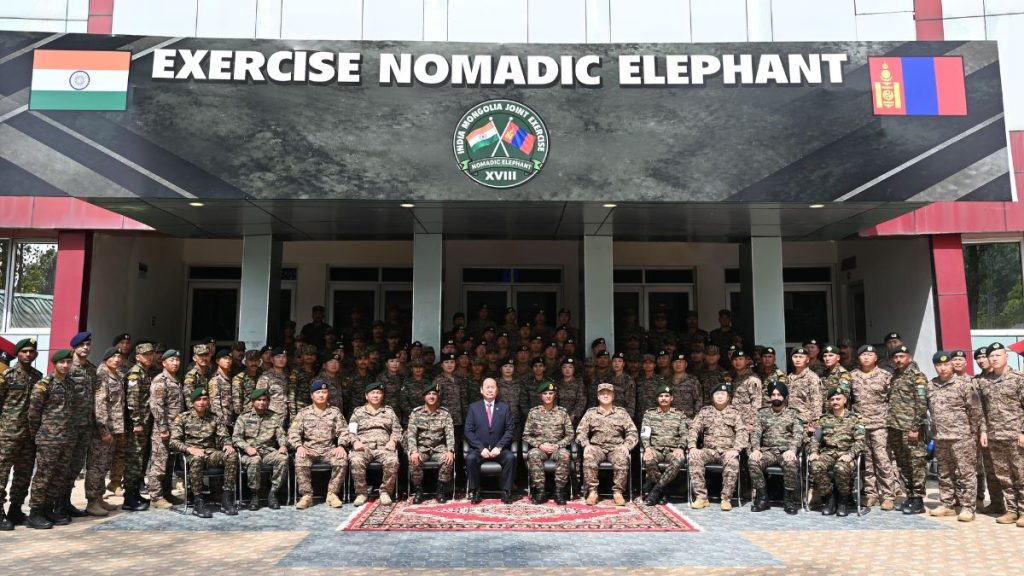
New Delhi: Indian and Mongolian troops are conducting small arms training, room-intervention drills and tactical exchanges at the 18th Exercise Nomadic Elephant 2026 at the foreign training node in Pithoragarh, Uttarakhand. The bilateral exercise, involving 45 personnel from each side, began on September 21 and will continue until October 3, with drones, counter-drone systems, cybersecurity training and special heliborne operations also included in the training programme.
Nomadic Elephant is an annual platoon-level exercise held alternately in India and Mongolia to improve joint capability for counter-insurgency operations in semi-urban and mountainous terrain under a UN mandate. The previous edition was conducted in Ulaanbaatar from May 31 to June 13, 2025, while the current curriculum also includes cordon-and-search operations alongside the newer technology-focused modules.
The defence ministry said the programme focuses on tactical-level operations, exchange of best practices, refinement of operational drills and interoperability. According to ANI, the ongoing training is also aimed at improving tactical proficiency and professional understanding, with Mongolian personnel undergoing weapon familiarization, safety drills, loading and unloading, aiming and firing practice.
The room-intervention demonstration covered systematic entry, room clearance, coordinated movement, communication, fire discipline and casualty evacuation. Such training requires small teams to move in a controlled sequence, maintain situational awareness and coordinate closely in confined spaces where reaction time is limited.
The exercise also brings newer battlefield technologies into conventional infantry training. Its official curriculum includes the employment of drones and counter-drone systems along with cybersecurity training, while special heliborne operations are intended to add an air-mobility component suited to difficult terrain.
The distinction is important: small arms and room-intervention training has already been reported from Pithoragarh, while the drone, counter-drone, cybersecurity and heliborne elements form part of the wider exercise curriculum.
Professional exchanges are being conducted alongside field training to help both contingents understand each other’s procedures and tactical practices.
Mongolian personnel have also showcased Mongolian classical wrestling, or Bokh, and unarmed combat, including traditional wrestling techniques, controlled grappling and close-combat movements. The demonstrations gave Indian troops an insight into Mongolia’s martial traditions while creating an informal avenue for interaction and mutual learning beyond the tactical training programme.
Nomadic Elephant gives the two armies a recurring platform to train together across semi-urban and mountainous scenarios while improving coordination at the tactical level. The current edition will continue at Pithoragarh until October 3, with interoperability and shared operational understanding remaining its stated objectives.