


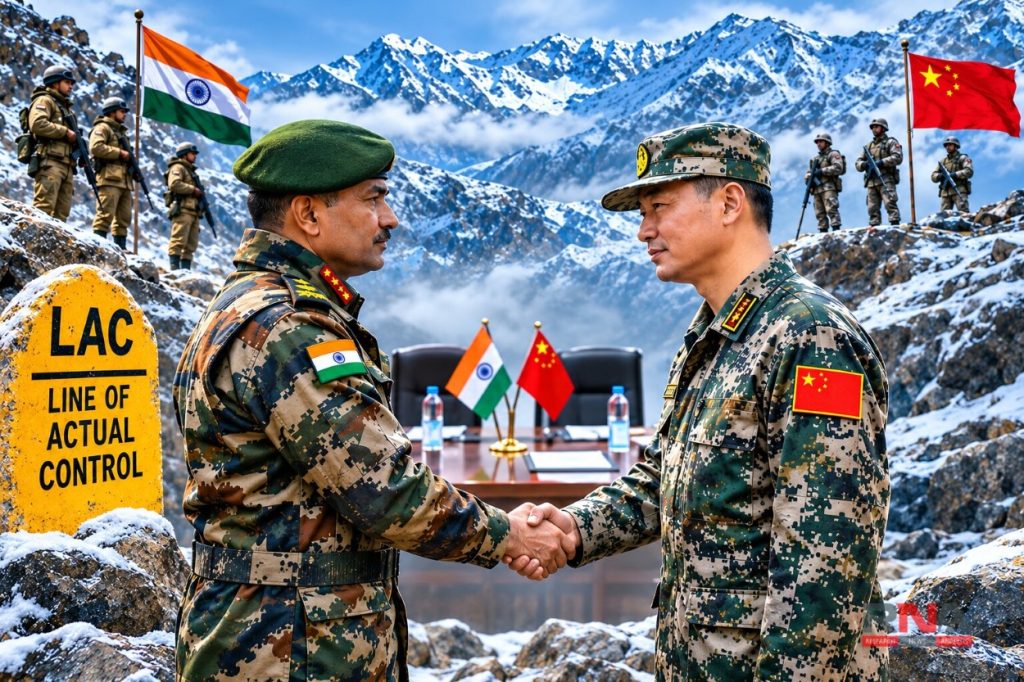
New Delhi: Senior Indian and Chinese military commanders have concluded another round of high-level negotiations to contain growing tensions along the line of actual control (LAC) in Arunachal Pradesh, where repeated confrontations between patrols have raised concerns about a renewed border standoff. The discussions, held ahead of the harsh Himalayan winter, underline the difficulties facing New Delhi and Beijing as they seek to stabilize bilateral relations without resolving their longstanding territorial dispute.
The second round of corps commander-level talks began on November 8 and continued for nearly 10 days, with a brief interruption, according to the Indian Express. The Indian delegation was led by Lieutenant General Girish Kalia, general officer commanding of the Army’s III Corps, headquartered at Rangapahar near Dimapur in Nagaland, with an official from the Ministry of External Affairs also participating in the discussions.
The negotiations focused on establishing clearer protocols for encounters between troops, maintaining communication between field commanders and preventing isolated incidents from developing into wider military confrontations. Although the exchanges were reportedly cordial, there has been no public confirmation of a comprehensive agreement or a timetable for implementing measures discussed during the meetings.
The latest engagement follows the first Corps Commander-level meeting in the eastern sector on September 6 and 7, held at the Wacha-Damai border personnel meeting point in Arunachal Pradesh’s Kibithoo sector. That meeting followed reports of increasing friction near Taksing in Upper Subansiri district, where differences over patrolling rights and territorial perceptions have repeatedly brought Indian and Chinese soldiers into close proximity.
Reports emerging since late July have also pointed to confrontations around Asaphila and adjoining areas, including allegations that Chinese troops established temporary encampments several kilometres inside territory claimed by India. Such accounts are difficult to verify independently because of the remoteness of the terrain and restrictions on access, but they have renewed scrutiny of Chinese military activity along the eastern frontier.
Official acknowledgement of continuing confrontations
The seriousness of the situation became clearer on October 22 when the then director-general of the Indo-Tibetan Border Police (ITBP), Shatrujeet Kapur, acknowledged that Indian and Chinese personnel had confronted one another at multiple locations in Arunachal Pradesh. His remarks were significant because they publicly confirmed continuing friction at a time when both governments were emphasizing the gradual improvement in their relationship.
Responding to the disclosure, the MEA said disturbances occasionally occurred when Chinese forces departed from established patrolling practices, reiterating that stability along the frontier was essential for progress in bilateral relations. As RNA Media reported in October, New Delhi attributed these disruptions to changes in Chinese patrolling behaviour, highlighting the continuing gap between diplomatic engagement and conditions on the ground.
The chief minister of Arunachal Pradesh, Pema Khandu, subsequently acknowledged that transgressions occurred periodically because the boundary remained disputed. He nevertheless maintained that Indian forces were effectively safeguarding the frontier and that such encounters should be understood in the context of the competing territorial claims.
Why Arunachal Pradesh remains strategically sensitive
The fundamental disagreement concerns the McMahon Line, drawn during the 1914 Simla negotiations between representatives of British India and Tibet, which India recognizes as its boundary with China in the eastern sector. Beijing rejects the arrangement and claims Arunachal Pradesh, which it describes as Zangnan or South Tibet, although New Delhi has consistently maintained that the state is an integral and inalienable part of India.
The dispute is particularly sensitive around Tawang, whose religious and historical links with Tibetan Buddhism give the region additional significance in Beijing’s territorial narrative. The absence of a mutually accepted LAC alignment also means that patrols following their respective countries’ territorial interpretations can encounter one another without either government acknowledging an infringement of its own claimed boundary.
The present tensions are not the first serious challenge along this frontier, which witnessed the 1986–87 Sumdorong-chu standoff and a violent clash near Yangtse in the Tawang sector in December 2022. These incidents demonstrate how competing claims, military deployments and infrastructure development can create conditions for confrontation even without an intention to initiate a wider conflict.
Diplomacy advances, but military mistrust persists
The latest military talks also form part of a broader diplomatic effort to rebuild relations following the deadly Galwan valley clash in June 2020, which left 20 Indian soldiers and at least four Chinese troops dead. Subsequent negotiations produced disengagement arrangements at several friction points in eastern Ladakh, but they did not settle the boundary dispute or eliminate the risk of fresh confrontations elsewhere along the LAC.
A significant development came on August 25 when the national security advisor, Ajit Doval, and the Chinese foreign minister, Wang Yi, held the 25th round of special representatives’ talks on the boundary question in Beijing. Their eight-point understanding included provisions for two additional senior military meeting points, new military hotlines in the eastern and middle sectors, and stronger mechanisms for addressing disagreements before they escalated.
These arrangements are intended to improve crisis management rather than deliver an immediate territorial settlement, particularly in areas where the two armies operate according to different interpretations of the LAC. Their effectiveness will depend on whether commanders can establish predictable patrolling practices, maintain reliable communication and ensure that instructions agreed at senior levels are implemented by troops deployed in remote areas.
Winter adds another operational complication, as snowbound mountain passes, extreme temperatures and difficult logistics restrict movement and complicate the maintenance of forward deployments. The approaching seasonal slowdown may reduce some patrolling encounters, but it does not necessarily remove the underlying disagreements or prevent renewed confrontations when military activity increases.
For New Delhi, the immediate objective remains preventing another serious border crisis without compromising its territorial position or military preparedness. The latest talks suggest that both governments recognize the risks of escalation, but whether diplomatic understandings can produce lasting stability in Arunachal Pradesh remains an open question.