


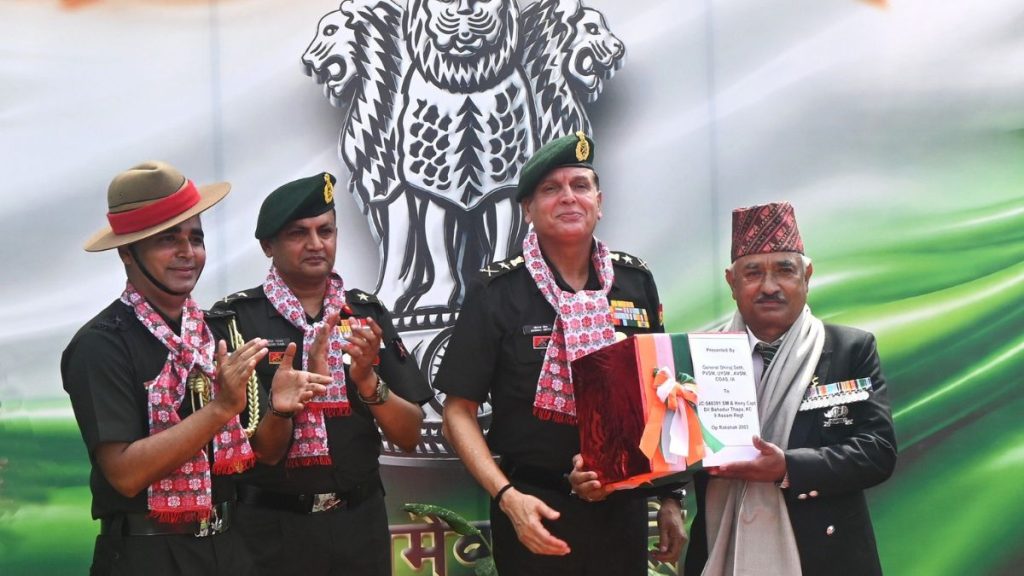
New Delhi: A former Gorkha soldier in Nepal directly urged the chief of the Army staff, General Dhiraj Seth, to resume the recruitment of Nepali youths into the Indian Army during his visit to Pokhara. Gen Seth made no commitment on restarting recruitment during the interaction, which came as part of a four-day visit to Nepal focused on strengthening military ties between the two countries.
The request came during Gen Seth’s interaction with veterans at the Pension Paying Office in Ram Bazaar, Pokhara, on August 19, according to the reports. Gaj Bahadur Thapa, central vice-president of the Nepal Bharatiya Gorkha Sainik Board and its coordinator for Gandaki province, raised the recruitment question with the Army chief.
The interaction followed a demonstration in Pokhara on August 12, when former Gorkha soldiers, their families and supporters called for Nepali youths to be allowed to join the Indian Army as Agniveers. The Indian Ex-Servicemen Gorkha Brigade Nepal Pokhara submitted a two-point memorandum to the federal government seeking the resumption of recruitment, according to the reports.
Gen Seth’s Nepal visit
The Gorkha recruitment demand came up during a veterans interaction rather than during Gen Seth’s formal bilateral engagements.
Gen Seth met Nepal’s prime minister, Balendra Shah, in Kathmandu and held talks with the chief of the Nepal Army, General Ashok Raj Sigdel. According to Nepal Army spokesman, Brigadier General Rajaram Basnet, the formal discussions centred on bilateral military relations, joint training and strategic cooperation.
As reported by RNA Media, Gen Seth’s meeting with Shah covered matters of mutual interest, while his separate discussions with Gen Sigdel focused on strengthening military-to-military cooperation. He also interacted with student officers at the Army Command and Staff College in Shivapuri.
The main purpose of the visit was the continuation of a longstanding military tradition. Nepal’s president, Ramchandra Paudel, conferred on Gen Seth the honorary rank of General of the Nepali Army, an honour reciprocally given to the army chiefs of India and Nepal that dates back to 1950.
The visit therefore covered the wider defence relationship between the two countries, while Gorkha recruitment remained a separate concern raised by veterans.
Why has Gorkha recruitment stopped?
Nepali citizens have a long history of serving in the Indian Army, but fresh recruitment from Nepal has not resumed since the process was disrupted during the Covid-19 pandemic and subsequently became linked to the introduction of Agnipath in 2022.
The Agnipath scheme changed the recruitment model for personnel below officer rank across India’s armed forces. Under the system, Agniveers serve for four years, after which up to 25% of each batch can be selected for enrolment in the regular cadre, based on objective criteria including performance and organizational requirements.
For those completing four years without being retained, the scheme provides a one-time “Seva Nidhi” package. The government has also put in place measures to help former Agniveers move into civilian employment, including skill recognition, employment opportunities and support for further education.
In March this year, the Ministry of Skill Development and Entrepreneurship said more than 325 skill sets acquired during military service had been mapped to industry requirements. The model is intended to give the armed forces a younger, more technologically oriented workforce.
How does Nepal view the Agnipath scheme?
Nepal has not allowed the recruitment of its citizens under the new system, with Kathmandu seeking clarity over how Agnipath fits with the arrangements governing Gorkha recruitment.
The 1947 Tripartite Agreement between India, Nepal and the United Kingdom has historically governed how Nepali citizens are recruited into, and serve in, the Indian and British armies. Nepal argues that Agnipath breaks from that earlier system in a significant way, and has sought talks with India to address the change.
Nepal’s foreign minister, Shisir Khanal, said in June that Kathmandu was willing to resume discussions with New Delhi on Gorkha recruitment, but indicated that the initiative would have to come from India, according to RNA Media.
India’s position has been set out more clearly in recent comments by the former chief of defence staff, General Anil Chauhan. He said the recruitment of Nepali Gorkhas into the Indian Army would be under Agnipath, and that the decision on whether Nepal wants its citizens to join under the scheme rests with the Nepal government.
Gen Chauhan also said there could not be one recruitment system for Nepali citizens and another for Indian citizens. His comments underline India’s position that Agnipath is now the standard recruitment framework for new entrants into its armed forces.
Why some Gorkha veterans want recruitment to resume soon
The demand from former soldiers is tied to jobs that recruitment has historically provided to young Nepalis, at a time when the country’s youth unemployment rate stood at around 20.6% in 2025, according to World Bank data.
At an event marking Gen Seth’s visit, Chandra Bahadur Khattri, a Gorkha veteran representative, said India could have had roughly 10,000 additional Nepali Gorkha soldiers by now had recruitment continued uninterrupted, calling the standoff “a missed opportunity for both sides,” as per the reports.
This week’s appeal in Pokhara was not an isolated one. Demonstrations were held in six towns across western Nepal in the days before Gen Seth’s visit, with young Gorkha aspirants and veterans demanding that recruitment resume soon.
Gen Seth’s visit did not produce a decision on the matter. The direct appeal from Gorkha veterans in Pokhara has, however, brought the issue back into focus, even as India and Nepal continue their wider military-to-military engagement.