


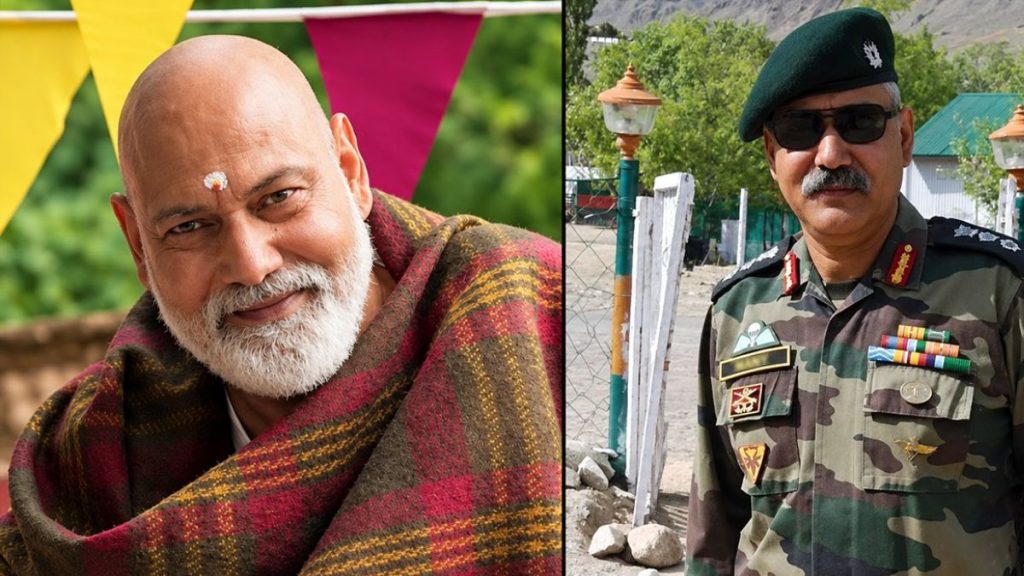
New Delhi: Retired Indian Army officer Colonel Munishwar Nath “Hunny” Bakshi, who once headed the now disbanded Technical Support Division (TSD) of Military Intelligence, has returned to public attention in an unexpected role, portraying the older Neem Karoli Baba in the 2026 film Hanuman Ansh. The cameo comes years after an army career that became closely associated with inquiries into the secretive intelligence unit and subsequent court-martial proceedings.
Col Bakshi, 61, says he approached the film’s director, Vishal Chaturvedi, with a script of his own and was offered the part after Chaturvedi felt he resembled the spiritual figure. Col Bakshi appears briefly in the framing sequence, while Shobhinaw Satyaa plays the younger Neem Karoli Baba through most of the film.
Neem Karoli Baba, widely known to followers as Maharaj Ji, was a Hindu spiritual figure whose teachings attracted followers in India and abroad. In Hanuman Ansh. A devotee of Lord Hanuman, Neem Karoli Baba became one of the best-known Hindu spiritual teachers associated with the bhakti tradition, emphasizing devotion, service and compassion.
He founded Kainchi Dham in the Kumaon hills of Uttarakhand, which remains a major pilgrimage centre associated with his legacy. His influence also extended internationally after American psychologist Richard Alpert met him in India in 1967, became his disciple and was given the name Ram Dass. Ram Dass later helped introduce Neem Karoli Baba’s teachings to a much wider western audience. The spiritual teacher died in Vrindavan in 1973, but his ashrams and following have continued to draw devotees decades after his death.
Col Bakshi portrays the older spiritual figure in a brief framing sequence, marking an unusual screen debut for a former military intelligence officer whose public profile had until then been shaped largely by his Army career and the TSD controversy. A recipient of the Vishisht Seva Medal (VSM), Col Bakshi was commissioned into the Military Intelligence Corps in December 1988 after training at the Indian Military Academy, Dehradun.
His career included assignments in Jammu & Kashmir and the northeast, as well as counter-IED and other military intelligence work. He has said publicly that he was involved in ceasefire related assignments in the northeast and survived three IED attacks during his service. From 2007 to 2010, he commanded an intelligence unit in Kolkata before being chosen to head the TSD, which was established in 2010 during the tenure of the-then Army chief, General Vijay Kumar Singh.
The unit was disbanded after Gen Singh retired in 2012 and became the subject of an army inquiry. Media reports at the time carried allegations involving unauthorized surveillance, handling of secret funds and other activities, claims that were disputed by Gen Singh and others associated with the unit. The central information commission later refused to disclose the inquiry report, saying it contained details of the unit’s objectives, methodology, tradecraft and secret service fund expenditure whose release could compromise national security.
Col Bakshi was attached to an armoured brigade in Nabha in October 2015 for disciplinary proceedings over allegations relating to safeguarding of classified information. He challenged the attachment and inquiry process before the Armed Forces Tribunal, while the proposed general court martial remained stalled for a period.
Court martial ended without conviction
The general court martial eventually began in Ambala in August 2017. In March 2018, it dropped all proceedings after accepting Col Bakshi’s plea challenging its jurisdiction. His defence had also raised objections over access to documents and the opportunity to cross-examine witnesses during the inquiry process.
The outcome meant there was no conviction, but the decision was procedural and did not amount to a judicial finding that every underlying allegation was false.
Col Bakshi continued serving until November 2019, when he took premature retirement. He has since said that he spends much of his time writing scripts for web series.
His appearance in Hanuman Ansh therefore adds an unusual second chapter to a public record that stretches from military intelligence and the disputed legacy of the TSD to writing and cinema, without erasing the distinction between allegations made against the unit and what the legal proceedings actually established.