


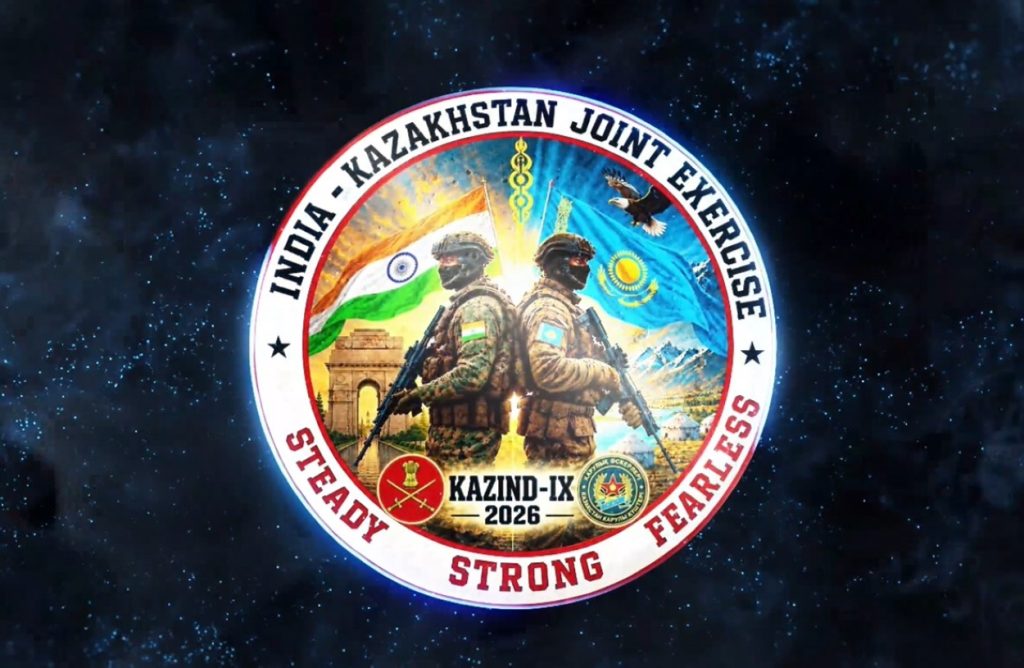
New Delhi: India has sent a 60-member military contingent to Kazakhstan for Kazind 2026, a joint exercise focused on counterterrorism operations in mountainous and semi-urban terrain. Scheduled from September 28 to October 11 at Oskemen, the training will combine ground manoeuvres, helicopter-supported operations and the coordinated use of drones and counterdrone systems.
The contingent departed on September 28 and comprises mainly personnel from a Garhwal Rifles battalion, alongside other Army arms and services and the Indian Air Force. Kazakhstan will deploy an equal number of personnel, drawn predominantly from its land forces, according to the defence ministry’s announcement.
The ninth edition will rehearse joint counterterrorism operations under a simulated United Nations mandate. Its programme includes raids, search-and-destroy missions, cordon-and-search operations, securing helicopter landing sites and special heliborne operations.
A joint command post and an intelligence and surveillance centre will support planning and coordination between the contingents. Training will conclude with a validation exercise in which the troops will apply the procedures rehearsed during the fortnight against a simulated terrorist threat.
The programme places ground operations, airborne movement and surveillance within a common training framework. Taken together, these elements suggest that the practical emphasis is on how the two forces share information and coordinate their actions, alongside proficiency in individual combat drills.
Kazind has gradually developed beyond its original Army-centred format, with air force participation becoming part of the exercise in 2023. The defence ministry’s account of that edition recorded the inclusion of air force contingents from both countries and training against unmanned aerial systems.
The series began in 2016 under the name Prabal Dostyk and was subsequently renamed Kazind after being expanded to company-level training. Its development into an exercise involving both ground and air personnel has provided a broader setting for practising counterterrorism tactics and learning each other’s operational procedures.
The eighth edition, held at Auli in Uttarakhand, ran from September 30 to October 13, 2024, and involved a 120-member Indian contingent built around a Kumaon Regiment battalion, with Air Force participation. Kazakhstan’s contingent included land forces and airborne assault troops, while the training covered mountainous and semi-urban operations.
Drones, counterdrone systems, intelligence coordination and helicopter-supported operations also featured in the Auli exercise. Their inclusion in the Oskemen programme therefore represents continuity in the training agenda, with both countries returning to capabilities already practised in earlier editions.
The relationship also has an operational foundation beyond bilateral exercises. In 2018, India and Kazakhstan agreed to deploy Kazakh personnel under an Indian battalion serving with the United Nations Interim Force in Lebanon, or Unifil, giving their troops experience of working together on an overseas peacekeeping mission.
According to the Indian embassy’s June 2025 bilateral brief, about 530 Kazakh armed forces personnel had participated in that mission by then. That experience helps explain the continuing attention to common procedures and multinational coordination in the exercise series, although Kazind itself remains a bilateral training activity.
Defence cooperation forms part of a strategic partnership established in 2009 and operates under an agreement on defence and military-technical cooperation signed in July 2015. Its scope includes military education, professional training, joint exercises, exchanges and technical cooperation, placing Kazind within a longer-running institutional relationship.
For the participating units, the concluding field exercise will be the practical test of that cooperation. It is intended to bring the separate training activities together, requiring Indian and Kazakh personnel to plan and execute a coordinated response to the same simulated threat.