


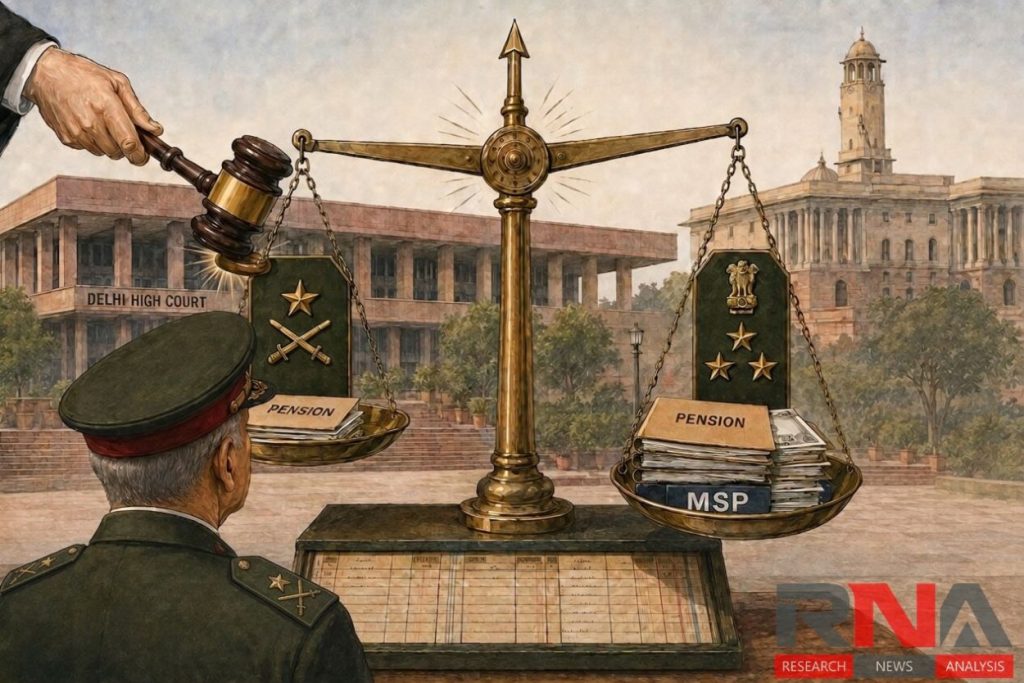
New Delhi: The Ministry of Defence has conditionally raised the pay and pension of 82 retired Indian Army major generals who had been receiving less than officers who retired one rank below them as brigadiers. The decision, issued more than three years after the Armed Forces Tribunal ordered the anomaly to be corrected, followed contempt notices from the Delhi high court to senior government officials.
An Army Headquarters letter dated August 31, 2026, authorized the officers’ pay to be stepped up retrospectively from the dates on which they assumed the rank of major general until their retirement. The difference will be classified as “personal pay” but treated as pay for all purposes, entitling the veterans to arrears and consequential benefits, the Tribune reported.
Their pensions will now be recalculated from their respective retirement dates, while enhanced leave encashment and applicable interest on delayed payments will also be released. However, the relief remains subject to the final outcome of the government’s challenge before the Delhi high court and any subsequent appeal in the Supreme Court.
The anomaly originated in the structure of “Military Service Pay”, or MSP, introduced on the recommendation of the Sixth Central Pay Commission to compensate personnel for the distinctive demands and restrictions of military service. Under the current rules, commissioned officers up to and including the rank of brigadier receive MSP of ₹15,500 a month, which is counted towards dearness allowance and pension, but officers of major general rank and above do not receive it.
Although promotion to major general places an officer in a higher pay level, the withdrawal of MSP could leave the promoted officer with lower overall reckonable emoluments than a senior brigadier. Under the Seventh Central Pay Commission structure, a brigadier’s pay could reach ₹2,33,100 after MSP, while the maximum prescribed for a major general was ₹2,18,200 without the allowance – creating an inversion in which greater rank did not necessarily produce higher pay or pension.
The defence ministry’s own Army Officers Pay Rules, 2017, recognize MSP as compensation for the special conditions of Army service and restrict it to officers up to brigadier. The government has also previously acknowledged that the allowance was intended to preserve a military “edge” over civilian pay scales and compensate for the rigours of service.
Retired officers began approaching the tribunal after discovering that their pensions had been fixed below those of brigadiers who had served immediately under them. One group led by Major General Sanjeev Chowdhry (retired) moved the tribunal’s principal bench in New Delhi, arguing that the anomaly violated the established service-law principle that a senior employee cannot be paid less than an immediate junior, according to earlier reporting by Times of India.
In a common judgment delivered in March 2023, the tribunal ruled in favour of the affected major generals and officers of equivalent rank in the other services. It ordered the government to step up their pay and pension and ensure that they did not receive less than their immediate juniors.
The government challenged the tribunal’s ruling in the Delhi high court, which admitted the petition but did not stay the judgement. The tribunal subsequently permitted conditional implementation after the petitioners submitted affidavits undertaking to abide by the court’s eventual decision, but the order remained unimplemented despite further execution directions.
The veterans then filed contempt petitions against officials including the defence secretary and the controller general of defence accounts. The high court issued notices requiring compliance by the next hearing, failing which the officials concerned would have to appear and explain the delay.
Under the latest arrangement, every beneficiary must again undertake to refund the money if a later high court or Supreme Court ruling overturns the tribunal’s decision. Similar orders are reported to have been issued for successful litigants of equivalent rank in the Navy and Air Force – rear admirals and air vice marshals – but the benefit has not been extended automatically to every similarly placed officer.
The decision therefore provides substantial relief to the litigants without yet removing the underlying structural anomaly across the armed forces. Unless the government introduces a general policy applicable to all affected officers, others in comparable circumstances may still have to seek individual legal remedies.