


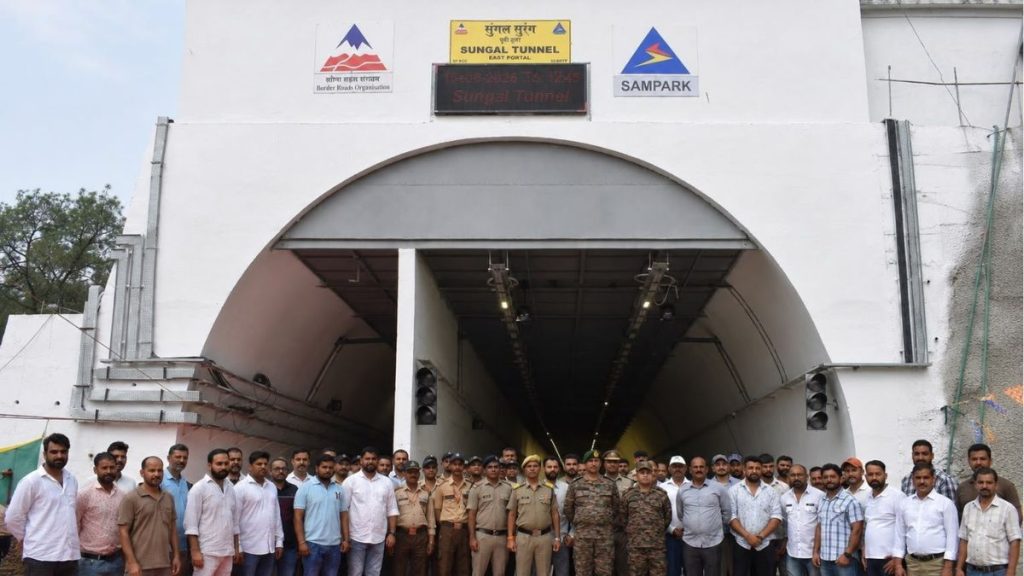
New Delhi: The Border Roads Organisation (BRO) opened the 2.79-kilometre Sungal tunnel on the Jammu-Poonch route to traffic on Sunday, strengthening connectivity towards the strategically important Rajouri-Poonch sector near the line of control (LoC). Built through the Kalidhar Range, the tunnel provides a shorter and more reliable passage across terrain where the existing highway has long been vulnerable to landslides.
The tunnel, constructed by BRO’s Project Sampark, is initially open to light motor vehicles between 8am and 8pm. BRO officials said traffic will be expanded progressively to heavy vehicles and round-the-clock movement after traffic patterns and safety aspects are assessed.
A difficult stretch bypassed
The most immediate change is practical. Bypassing the existing section across the Kalidhar Range reduces the road distance by about 12 kilometres and cuts the journey by roughly 45 minutes, according to BRO officials. The new alignment also avoids a difficult, landslide-prone portion of the highway on the route connecting Jammu with Nowshera, Rajouri and Poonch.
The main civil works were completed about a month before the opening. BRO subsequently checked the tunnel’s ventilation, fire-fighting systems and emergency lighting before allowing regular traffic through it.
For now, the phased opening means the project has not yet reached its final operating pattern. The eventual move to all categories of vehicles and 24-hour traffic will follow further safety and movement assessments.
Why the route matters
The Jammu-Poonch axis connects the Jammu region with Rajouri and Poonch, two border districts adjoining the LoC. The road serves local communities and commercial traffic but also passes through an area where reliable connectivity has clear strategic importance.
The tunnel is important for military logistics in the vicinity of the LoC while also improving access for people in Poonch, Rajouri and Nowshera.
The strategic relevance has also been acknowledged by the BRO. At the Sungal tunnel breakthrough in May 2024, then Border Roads director general Lieutenant General Raghu Srinivasan described Poonch, Rajouri and Akhnoor as important defence locations and said improved connectivity contributed to defence preparedness. He also said the highway upgrade and its four tunnels were intended to provide all-weather connectivity and safer travel.
That does not imply a specific military use for the Sungal tunnel. Its significance lies in removing a vulnerable road section and making movement towards the border districts faster and more dependable.
Part of a larger highway upgrade
The Sungal tunnel cost about ₹600 crore, according to BRO officials. Work began in September 2021 and the tunnel breakthrough was achieved in May 2024.
It is the longest of four tunnels on the Akhnoor-Poonch road. The 260-metre Kandi tunnel is already operational, while the 700-metre Nowshera tunnel and 1.1-km Bhimber Gali tunnel remain under construction.
Together, the tunnels are intended to take traffic away from difficult mountain stretches rather than simply widen the existing road.
BRO’s wider border connectivity push
The Sungal project fits into a wider expansion of strategic infrastructure being undertaken by BRO in border and inaccessible regions.
A government backgrounder published in January 2026 describes BRO’s mandate as building and maintaining roads, bridges, tunnels and airfields for military and civilian requirements. It said the organisation recorded its highest-ever expenditure of ₹16,690 crore in FY 2024-25, reflecting the scale of the continuing infrastructure push.
Poonch also figures in BRO’s longer-term plans. Its approved Trans-Kashmir Connectivity project envisages an alignment of about 717 kilometres from Poonch to Sonamarg, with tunnels across important mountain passes aimed at improving all-weather and inter-sector connectivity.
The Sungal tunnel is a smaller piece of that broader network, but its impact is immediate: fewer kilometres, less time on a difficult stretch and more dependable access towards Rajouri and Poonch.
Once heavy and round-the-clock traffic is allowed, the tunnel will remove a difficult terrain bottleneck on the road towards the two border districts.