


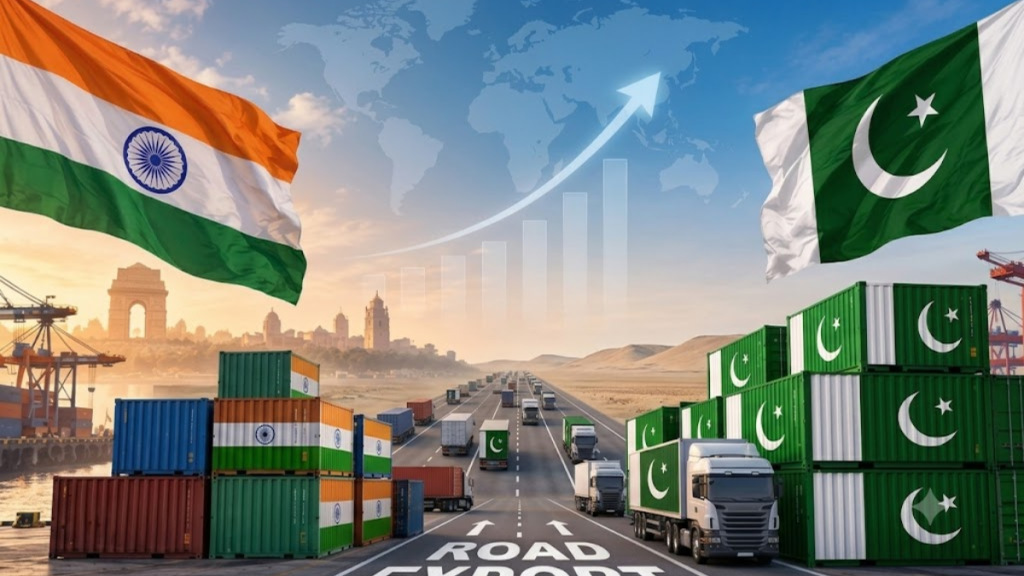
New Delhi: From July to September 2026 Indian products worth $61.74 million entered Pakistan despite India having imposed trade restrictions on Pakistan. There was a nearly 70 per cent increase in the total value of imports (which were at $36.55 million in the corresponding period of the previous year).
The increase also comes despite restrictions imposed by both countries on direct and indirect trade. While Pakistan recorded no exports to India during the first quarter of the 2026-27 financial year, its imports from India continued to rise. The latest figures have drawn attention to the possibility of Indian goods reaching Pakistan through third-country trade routes.
According to figures compiled by State Bank of Pakistan and published in Dawn, the imports of Pakistan from India have increased from $36.55 million in July-September 2025 to $61.74 million in the corresponding quarter of 2026. The figures do not reveal the point of origin and transit route of each consignment.
Increasing imports indicate the need for Indian products in Pakistan but the exact route is unknown. The geopolitical expert Ravinder Singh Robin raised question if these goods were making way to Pakistan from other countries because of the trade ban. He also said if there was any considerable demand for these goods, Pakistan could take concrete steps against terrorism to establish healthy relations.
How Indian goods reach Pakistan through third-country trade routes
A study by the Global Trade Research Initiative (GTRI) issued on April 25, 2025 had described the way through which Indian goods can be transported to Pakistan through transit stations like Dubai, Singapore, and Colombo.
In the process, the exporter in India sends goods to a third party’s port, which would be taken care of by another firm and kept in a bonded warehouse.
The goods are then re-labelled and documents modified to indicate that the country in transit is the country of origin. For instance, goods manufactured in India can be re-labelled as goods manufactured in the UAE and shipped to Pakistan. In this case, it will seem like the goods were shipped from a third country and not India. GTRI also called it a “grey-zone strategy”.
Medicines are some of the primary products from India that are imported into Pakistan. Some other products are plastics, oil products, dyes, organic chemicals, rubber, coffee, tea, vegetables, spices, and cereals.
India-Pakistan trade restrictions
In response to the terror attack that took place in April 2025 in Pahalgam where 26 innocent lives were lost, India put on hold all the business activities with Pakistan. The Wagah-Attari border crossing was closed by India since it was the only approved land point for trade between the two countries.
Pakistan also announced a suspension of all trade with India, including through third countries, in May 2025.
The new import data has emerged against the background of the overall trade deficit situation in Pakistan’s neighbouring countries. The trade deficit between Pakistan and its nine neighbours rose by 26.62 per cent to reach $4.97 billion during July-September 2026. While imports from these countries increased by 19.79 per cent to touch $5.92 billion, exports fell by 6.72 per cent to reach $944.24 million.
However, while Pakistan’s data shows a rise in imports from India to $61.74 million, it does not confirm whether these goods reached the country through third-country routes. The route taken by the shipments remains unclear.