


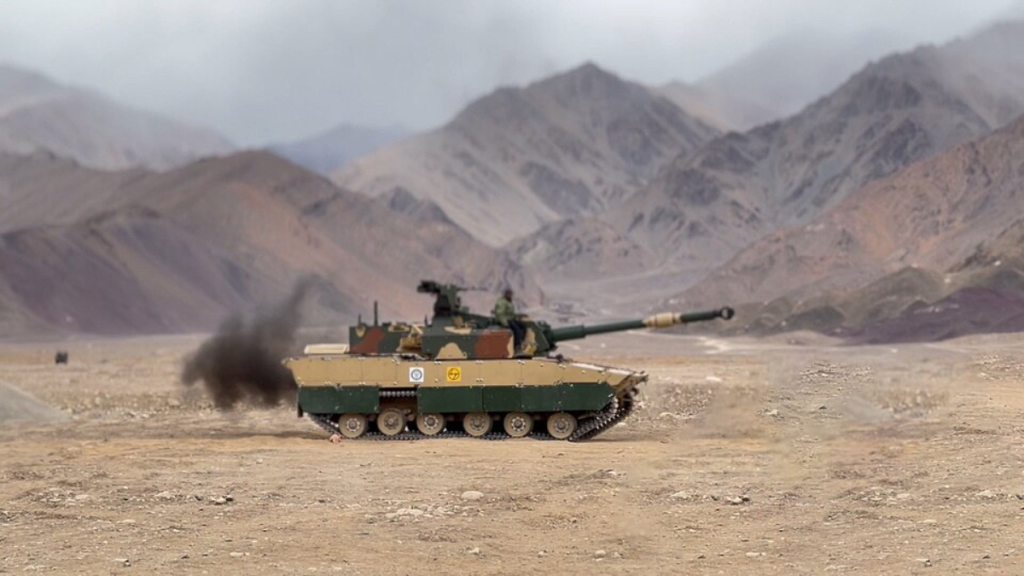
New Delhi: The indigenous Zorawar light battle tanks, key to India’s armoured defence of its borders with China, will be inducted only by 2028-29 as their deployment plans are delayed due to developmental issues, Indian Army chief General Upendra Dwivedi has said. The Zorawar tanks, when deployed, would boost India’s ability to counter the Chinese People’s Liberation Army’s armoured columns along the line of actual control (LAC) – a key gap in the defence architecture noticed during the 2020-2024 military faceoff between the two nations in eastern Ladakh.
“Issues noticed during development and testing are being addressed through the normal design refinement cycle. Based on present timelines, Zorawar’s induction is likely in the 2028-2029 timeframe, subject to successful completion of trials, user evaluation, and production readiness,” Gen Dwivedi said in an interview with Hindustan Times on June 4, but published on June 7. The army chief said the induction of the Zorawar tanks would significantly improve military deployment, troop induction speed, and the armoured regiments’ combat response in the mountains, without explicitly mentioning China or the Ladakh conflict.
The developmental issues that needed solutions included enhanced protection against enemy fire, which could mean an alteration in the power-to-weight ratio of Zorawar tanks, which currently have a STANAG Level 4 protection to defeat machine gun fire, artillery shrapnel, and limited mine blasts, the Economic Times reported on Thursday, quoting unnamed sources familiar with the matter. The induction of the advanced tanks would be delayed by two years, though it had been offered for induction in early 2027, the report said.
The Chinese PLA has already inducted and deployed several modern tanks, including the light armoured vehicles with a high power-to-weight ratio, along the LAC with India. To counter the Chinese tank deployment, India was forced to deploy the heavier Russian-origin T-72 and T-90 main battle tanks in Ladakh during the four-year conflict that ended with de-escalation in 2024. The heavier tanks have their limitations in high-altitude mountainous terrains, as they were originally designed for deployment in the flat plains and desert terrains. In response to China’s Ladakh deployments, India developed the Zorawar tanks in two years, a record of sorts, after consultations among the army, defence research agencies, and the private industry.
Indian Army light battle tanks induction plans
The Indian Army has projected a requirement of 354 light battle tanks at an estimated cost of ₹17,500 crore. Zorawar, a 25-tonne tank, is a showcase product of India’s domestic defence manufacturing prowess, the Army chief said. Developed by the Defence Research and Development Organisation (DRDO), Larsen & Toubro is the production partner under “Project Zorawar”. While L&T would supply the first 59 Zorawar tanks, the remaining 295 tanks required by the Army will be produced by a company chosen through a competitive process as a separate project.
“It (the tank) is being designed as a light, agile, and technologically advanced armoured platform tailored for our terrain, especially high-altitude areas. The requirement is for a protected, mobile, manned-unmanned teaming-enabled platform with substantial firepower, surveillance, and communication capabilities,” the army chief was quoted as saying by HT.
The Zorawar tank would be light enough to be airlifted to remote mountainous terrain, be capable of performing amphibious assault operations, and fire at higher angles of elevation to serve as limited artillery.
Referring to India’s “unique” geography and security environment spanning mountains, deserts, jungles, plains, riverine areas, island territories, and long unsettled borders, the army chief said: “This demands preparedness across all five generations of warfare, from traditional contact battles to hybrid, non-contact, technology-driven and cognitive warfare. We need Indian solutions for Indian challenges because our terrain, threat matrix, and operational demands are unique. Indigenisation is central to the army’s modernisation journey.”
Gen Dwivedi’s comments came just a day ahead of the prime minister, Narendra Modi, reviewing the prototype of the Zorawar tank at L&T’s Hazira facility in Gujarat. After inspecting the Zorawar prototype last Friday, Modi posted on X: “The role played by L&T in furthering self-reliance in the defence sector is commendable.” The indigenous light tank has been named after the legendary general, Zorawar Singh, who led the Dogra forces a record six times to victory in battles between 1834 and 1841 in the Ladakh and Tibet region against the then Chinese forces.