


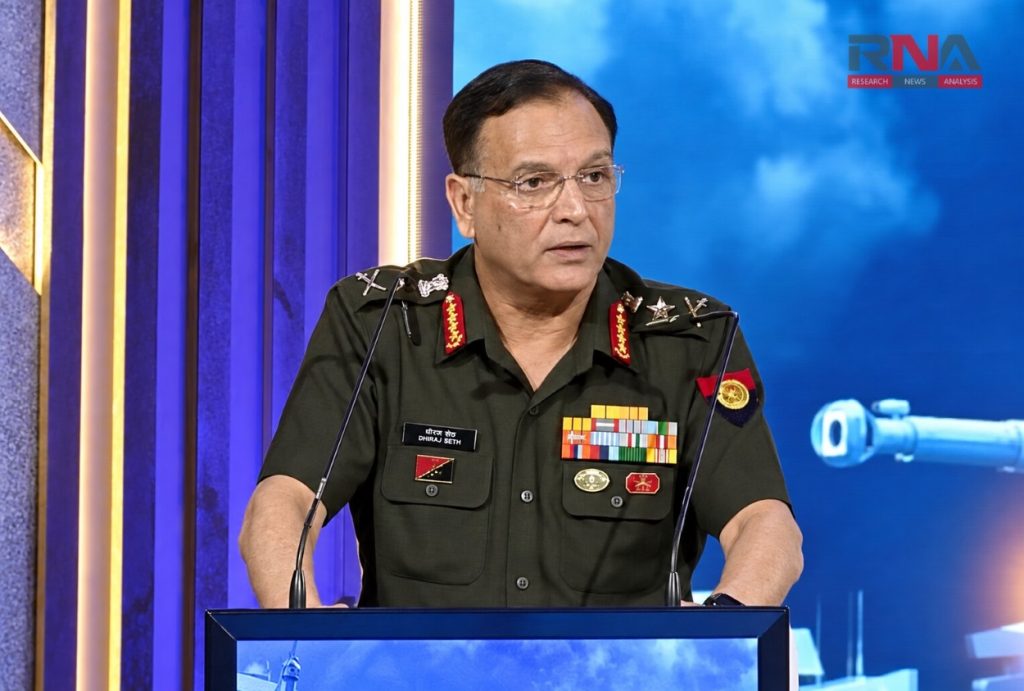
New Delhi: The chief of the Army staff, General Dhiraj Seth, on Sunday, outlined a seven-point vision to strengthen the Indian Army’s ability to sustain prolonged conflicts and respond faster to changing battlefield threats. Presented at the NDTV Defence Summit, the framework, called Samarth, places operational endurance, technological adaptation and better-equipped soldiers at the centre of military preparedness.
His central argument was that faster battlefield engagements do not necessarily produce shorter wars, making the capacity to replenish, recover and continue fighting increasingly important. Seth also stressed that defence self-reliance must encompass the ability to sustain and upgrade military capabilities, extending beyond domestic manufacturing alone.
“Technology may be shortening battles, but it is not necessarily shortening wars,” he said, describing conflicts punctuated by interruptions as “wars with pause”. The distinction carries an operational warning: a lull in fighting cannot automatically be treated as the end of a military confrontation.
Samarth, a Hindi word meaning capable, brings together sustainability, adaptation, modernization, acceleration, resilience, technology and human-machine teaming. These priorities seek to connect the Army’s longer-term transformation with its immediate operational requirements.
Seth’s description of acceleration included integrating capabilities that improve the effectiveness of existing military systems, alongside introducing new technology. Artificial intelligence, autonomous systems, robotics and drones featured among the technologies he identified, with human-machine teaming intended to improve soldiers’ awareness and judgement.
“Technology must make our soldiers faster, better informed and more effective,” he said. That formulation makes the soldier’s effectiveness the practical measure of technological progress.
The address also drew attention to the mismatch between rapid technological advances and the slower process of developing usable military capabilities. Seth’s assessment suggests that procurement, integration and training must advance together if new equipment is to provide a timely operational advantage.
The framework builds on priorities already being examined within the Army’s senior leadership, giving the announcement an institutional foundation beyond the summit speech. At this year’s Army Commanders conference, held from April 13 to April 16, commanders reviewed modernization, technology in combat, doctrine and training as interconnected requirements for operational readiness.
The defence ministry said those discussions drew on lessons from Operation Sindoor and developments in conflicts elsewhere, with particular attention to unmanned aerial systems and counterdrone capabilities. Commanders also emphasized accelerating indigenous production to strengthen resilience against supply-chain disruption, an issue directly relevant to sustaining a force through extended hostilities.
The Army has designated 2026 as its year of networking and data centricity, reflecting the importance it attaches to connecting capabilities and improving the use of information. Read alongside the April deliberations, Samarth suggests continuity between that work and Seth’s emphasis on shortening the time needed to translate technological progress into battlefield capability.
There is also a substantial material dimension to the endurance argument, particularly in ammunition supply. The defence ministry’s 2025 year-end review reported that 159 of the Army’s 175 ammunition variants – approximately 91 per cent – had been indigenized, although 110 were being obtained from a single domestic source.
The same review described a programme to strengthen ammunition stocks, reduce import dependence and develop additional manufacturing sources, including an eventual objective of at least two sources for each ammunition type. Those details illustrate why domestic production and supply resilience are related but distinct requirements: local manufacture provides an important foundation, while supplier diversity helps protect continuity of supply.
Organizational changes have accompanied these procurement efforts, showing that the Army’s transformation extends to how forces are structured and employed. A defence ministry statement issued on June 30 identified Rudra brigades, Bhairav battalions, Ashni drone platoons, Shaktibaan regiments, Divyastra batteries and electronic warfare brigades among initiatives progressed under its ongoing transformation programme.
Taken together, these developments give Samarth a practical context: the Army is pursuing changes in equipment, supply arrangements, information systems and force organization simultaneously. The operational test will be whether these efforts deliver formations that can absorb disruption, maintain their fighting strength and adapt quickly enough to preserve the initiative.