


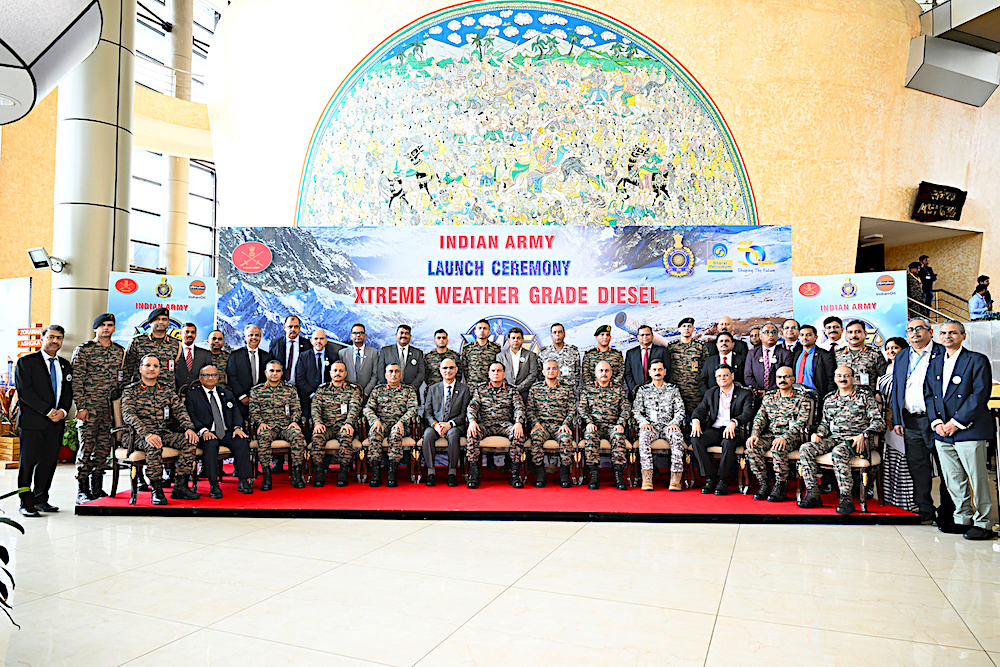
New Delhi: The Indian Army chief, General Dhiraj Seth, launched an indigenously developed Xtreme Weather Grade (XWG) diesel on Friday. During the event, he described it as a significant step forward for the mobility and operational readiness of Army vehicles deployed in extreme cold and high-altitude terrain.
The fuel, developed jointly by the Indian Army and Bharat Petroleum Corporation Limited (BPCL), remains fluid at temperatures as low as minus 42-degrees celsius. This addresses a longstanding problem in sectors such as Ladakh and Siachen, where conventional diesel tends to thicken and clog fuel filters in severe cold, affecting vehicle mobility.
XWG diesel complies with BS-VI emission norms and the IS 1460:2025 specification, and can be used across the Army’s existing vehicle fleet without engine modification or fresh homologation.
‘Developed within a year’
Gen Seth, addressing the launch ceremony in Delhi, called the fuel a real game changer for operations in high-altitude and extreme-temperature zones, and described the Army-industry partnership that produced it within a year as an example of Atmanirbhar Bharat – the government’s self-reliance push.
Drawing on his background in the Armoured Corps, he said much of his early career had revolved around tracking diesel stocks and calculating the range of armoured vehicles, an experience that shaped his appreciation of the advantage the new fuel offers to both tanks and lighter transport vehicles operating in the cold.
The Army chief also thanked the Directorate General of Supplies and Transport and other oil companies that have since committed to similar development work, and said he expected the collaboration to produce further specialized fuels for the Army’s diverse operational requirements.
Fuel expected to ease troop hardships
Conventional diesel is prone to waxing in subzero conditions – a process in which paraffin content begins to crystallize below a certain temperature, clogging filters and injectors. This has historically forced troops to keep engines idling through the night or resort to other workarounds simply to keep vehicles operable.
Seth said XWG diesel would remove the need for such practices, easing the fatigue and morale strain on soldiers deployed through harsh winters. Officials said the technology would also benefit civilian transport in high-altitude and severe-winter regions, including parts of Ladakh and the wider Himalayan belt.
Builds on years of efforts
The launch extends a line of winter-specific fuel development that has included the Indian Oil Corporation’s winter-grade diesel for Ladakh, introduced in 2019 with a pour point of around minus 33-degrees celsius. XWG diesel’s minus 42-degree threshold marks a notable improvement over that benchmark.
BPCL has said it will draw on stocks from its Bina refinery, with strategic stocking at Bathinda, to keep supplies uninterrupted. The chairman and managing director of BPCL, Sanjay Khanna, said the fuel had been validated through extensive field trials with Army teams at a high-altitude location, calling it a demonstration of the scientific and engineering capacity behind Atmanirbhar Bharat.