


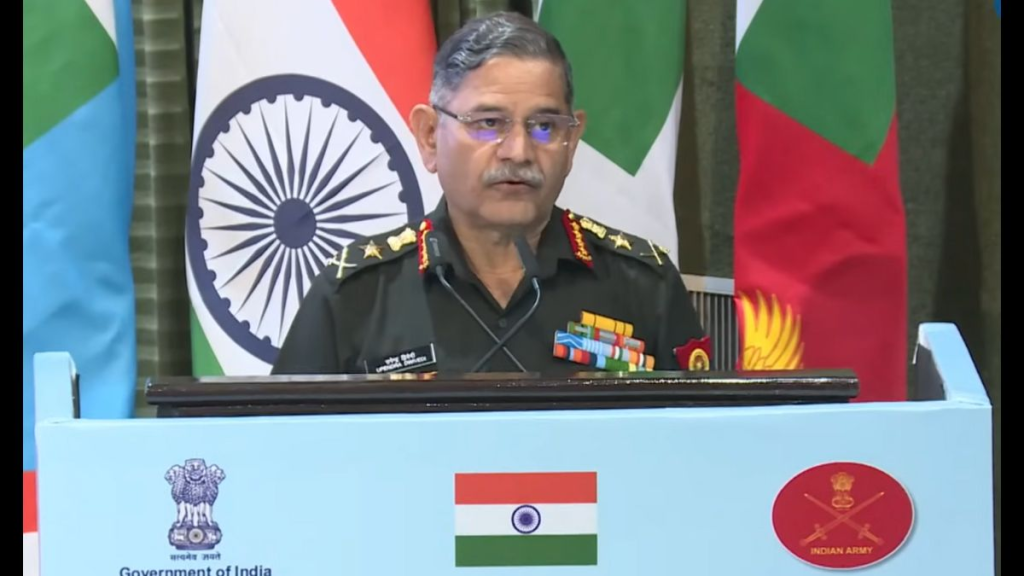
New Delhi: The Indian Army is enhancing its technology-driven transformation following Operation Sindoor, with a renewed focus on drones, electronic warfare, integrated combat formations and future-ready force structures. The chief of Army staff, General Upendra Dwivedi, said the changing character of warfare is driving the Army’s efforts to build a force that is agile, networked and capable of operating across multiple domains.
According to an interview given by Gen Dwivedi to Deccan Herald, future conflicts are expected to be multi-domain, technology-intensive and increasingly non-linear, requiring the integration of land, air, cyber, space and electromagnetic capabilities. To meet these challenges, the Army is undertaking major force restructuring under its decade of transformation (2023–2032).
As part of this effort, the Army has begun operationalising new-age formations including Rudra Brigades, Bhairav Battalions, Ashni drone platoons, Shaktibaan regiments and Divyastra batteries. Two Rudra brigades have already been raised and three more are planned for the future. The Army currently has 21 Bhairav battalions, with the number expected to rise to 25. Around 382 Ashni drone platoons are also being introduced to enhance battlefield surveillance, target acquisition and tactical drone operations at the unit level.
According to reports, the concept of integrated battle group (IBG) has undergone extensive testing and refinement, and a mountain strike corps is expected to be reorganized into IBGs in the near future. Electronic-warfare brigades are also being raised to strengthen the Army’s ability to operate in contested electromagnetic environments and counter emerging threats.
Gen Dwivedi also highlighted progress on theaterization, describing it as a necessary reform for future warfare. He said the proposal for integrated theatre commands has been submitted to the government, while substantial groundwork on joint planning, command structures, logistics, communications and training has already been completed. The reform will be implemented in phases once approved, with the aim of improving jointness and operational effectiveness across the armed forces.
On the northern borders, the Army chief described the situation as “stable but sensitive”. While disengagement agreements and renewed military and diplomatic engagements have improved stability, he stressed that the Army would continue maintaining a robust deployment posture. Infrastructure development, surveillance, logistics and mobility enhancement along the frontier remain key priorities.
Discussing manpower reforms, Gen Dwivedi said initial feedback on the Agnipath scheme has been encouraging, with Agniveers adapting well to operational units and modern technologies. He noted that any future review of retention levels would be guided by operational requirements and institutional feedback.
Highlighting lessons from recent conflicts, including the India-Pakistan confrontation that brought drone warfare to South Asia, the Army chief underscored the growing role of drones, counter-UAS systems and loitering munitions. He said the Army is working closely with industry through long-term capability development and acquisition plans to provide greater visibility of future requirements, helping accelerate indigenous production and technological innovation.