


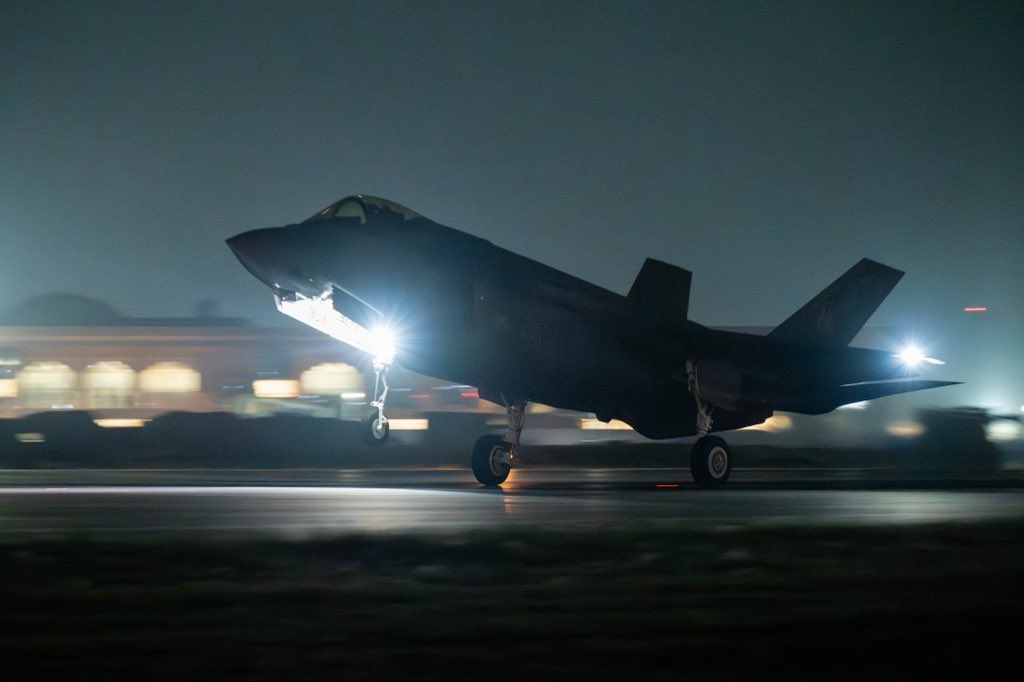
New Delhi: The United States has made no formal offer to sell F-35 stealth fighters to India, the chief of the air staff, Air Chief Marshal Amar Preet Singh, said on Saturday, clarifying the status of a possible acquisition that has attracted considerable speculation. He also said the government had yet to decide whether the Indian Air Force (IAF) should evaluate Russia’s proposed Su-57 fighter, leaving both foreign fifth-generation options without a confirmed procurement decision.
Speaking at a news conference during the concluding ceremony of Exercise Tarang Shakti 2026 in Jodhpur, ACM Singh distinguished reports about the aircraft from an official American offer. His clarification came as US F-35s participated in the multinational exercise, bringing the aircraft into closer operational contact with the Air Force.
Seated alongside the commander of US Pacific Air Forces, General Kevin Schneider, ACM Singh responded to a question about the possible sale with a joke: “Your people don’t even let us go near the aircraft, and you are talking about selling it to us.” He subsequently explained that Indian personnel had not been shown the cockpit, although they had flown in close formation with the American fighters.
ACM Singh cautioned against taking the remark seriously and acknowledged that countries protect sensitive military technology, including information India itself does not share with the US. Schneider explained that access to F-35 information was governed by programme security rules rather than decisions he could take personally.
On the Russian proposal, ACM Singh said a government decision would be required before the Air Force assessed whether the Su-57 met its operational needs. His remarks indicated that awareness of an offer had not yet translated into a decision to evaluate the aircraft, much less an agreement to purchase it.
The F-35 discussion dates back to the meeting between the prime minister, Narendra Modi, and the US president, Donald Trump, in Washington on February 13, 2025. Trump publicly expressed an intention to pave the way for an eventual sale, but the foreign secretary, Vikram Misri, subsequently said India’s acquisition process for the aircraft had not begun.
The India-US joint statement committed Washington to reviewing its policy on releasing fifth-generation fighters and undersea systems to India. That wording established a policy review rather than a purchase agreement, an important distinction when assessing subsequent reports about an F-35 deal.
India reiterated that position in Parliament on August 1, 2025, when the minister of state for external affairs, Kirti Vardhan Singh, said no formal discussions had been held on the issue. The Air Force chief’s latest statement therefore reinforces the distinction between political interest in a possible sale and a formal procurement proposal.
The aircraft’s appeal lies in its combination of reduced radar visibility, advanced sensors, electronic warfare and the ability to combine information into a clearer picture of the battlespace. As Lockheed Martin’s technical description explains, stealth makes the F-35 harder to detect and target; it does not make the aircraft invisible.
Alongside consideration of foreign aircraft, India is pursuing its own advanced medium combat aircraft (AMCA) programme. On May 27, 2025, the defence minister, Rajnath Singh, approved an industry partnership model under which the Aeronautical Development Agency would work with an Indian company, joint venture or consortium, with public and private firms eligible to compete.
The domestic project remains in development, with the deadline for industry proposals extended to October 30. Developing prototypes and bringing an operational fighter into service are separate stages, making AMCA’s progress relevant to the debate over an interim foreign acquisition.
Meanwhile, Tarang Shakti demonstrates that operational cooperation can proceed without an aircraft purchase agreement. The defence ministry said the exercise was scheduled from September 26 to October 12, involving India and seven foreign air forces, with 32 observer nations, to develop joint planning and interoperability.