


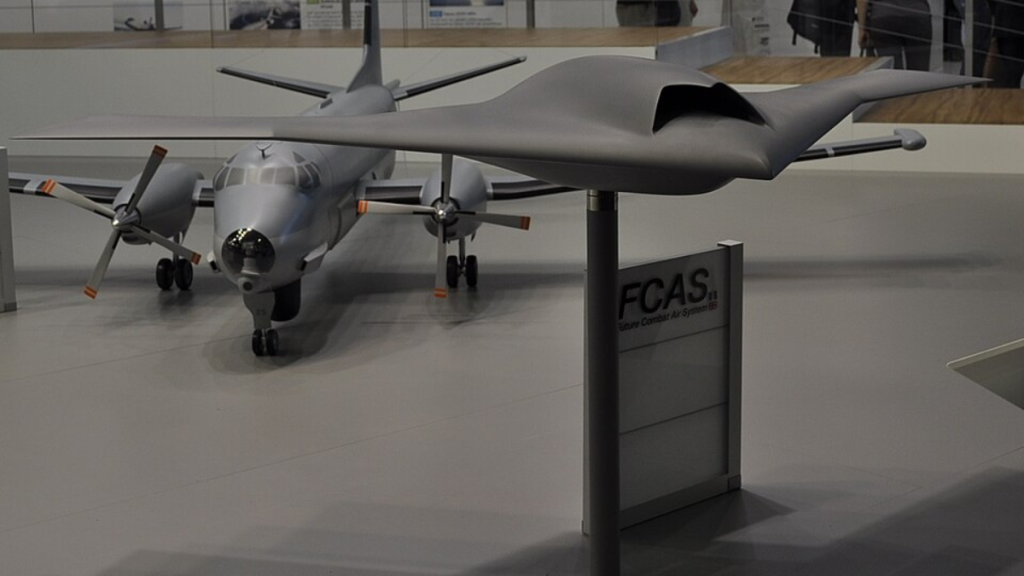
New Delhi: India had initiated efforts to join Europe’s “future combat air system” (FCAS) 6th-generation fighter programme before the Franco-German aircraft project at its centre collapsed in June, according to disclosures contained in a parliamentary report. The development leaves New Delhi’s prospective cooperation with France in advanced combat-aircraft technologies requiring a fresh framework if the two countries decide to pursue it.
The parliamentary Standing Committee on Defence, in its latest “action taken” report, said the Ministry of Defence had informed it that efforts had been initiated to “co-join the 6th-generation fighter aircraft-development programme” under the FCAS. The ministry described the initiative as being spearheaded by the French government and said India was considering participation as part of efforts to strengthen its future air-combat capabilities.
However, the disclosure comes after France and Germany abandoned plans in June to jointly develop the new-generation fighter, or NGF, the manned 6th-generation aircraft that was intended to form the centrepiece of FCAS. The decision followed years of disagreement between France’s Dassault Aviation and Airbus Defence and Space over leadership, workshare and responsibility for designing the aircraft.
The original parliamentary deliberations that led to the committee’s recommendation took place well before the collapse. In its report adopted in March, the committee had urged the government to prioritize technological upgrades for combat aircraft and begin planning for the development or acquisition of 6th-generation fighters, given their expected importance in future warfare.
During those deliberations, India was examining the two major European 6th-generation fighter initiatives then under development. These included FCAS involving France, Germany and Spain, and the “global combat air programme” involving Britain, Italy and Japan.
The latest committee report records the defence ministry’s response that India had begun efforts to participate in FCAS and asks the government to provide a detailed status report, roadmap and tentative timeline in its subsequent “action taken” statement. The publicly available parliamentary material, however, does not establish that India has joined any new French fighter programme created after the collapse of the Franco-German NGF project.
FCAS was launched in 2017 as a broader networked air-combat programme designed around a future fighter operating alongside unmanned aircraft, sensors, remote carriers and a digital “combat cloud”. France, Germany and Spain had envisaged the system entering service around 2040 to replace aircraft including France’s Rafale and Germany and Spain’s Eurofighter Typhoon fleets.
The collapse of the joint fighter project does not mean that the entire FCAS framework has been abandoned. France and Germany have indicated that work can continue on some of the wider system-of-systems, networking and combat-cloud elements even though they will no longer jointly develop the NGF in its earlier form.
France, meanwhile, still faces the requirement of eventually developing a successor to the Rafale. Dassault has indicated that France has the capability to develop a future combat aircraft independently but could also consider cooperation with international partners.
That leaves open the possibility of India and France eventually developing a new partnership around 6th-generation combat-aircraft technologies. Such cooperation, however, would have to be based on a newly defined programme or arrangement rather than being presented as India simply joining the Franco-German fighter project that existed when the parliamentary discussions began.
India has a longstanding aerospace and defence relationship with France, with the Rafale already forming an important part of the Indian Air Force’s combat fleet. New Delhi has also selected the naval version of the fighter for the Indian Navy, deepening industrial and operational ties with France in combat aviation.
For India, participation in a future 6th-generation programme could offer access to technologies ranging from advanced sensors and low-observable design to artificial intelligence, collaborative unmanned systems, networking and next-generation propulsion. Any such partnership would, however, depend on the structure of a future French programme, the extent of technology sharing and the industrial role offered to Indian companies.
The committee has sought further details from the defence ministry on the status and proposed timeline of India’s 6th-generation fighter plans. A subsequent government response could clarify whether the earlier FCAS initiative has been abandoned, reworked or transformed into discussions with France on a new bilateral or multinational combat-aircraft programme.