


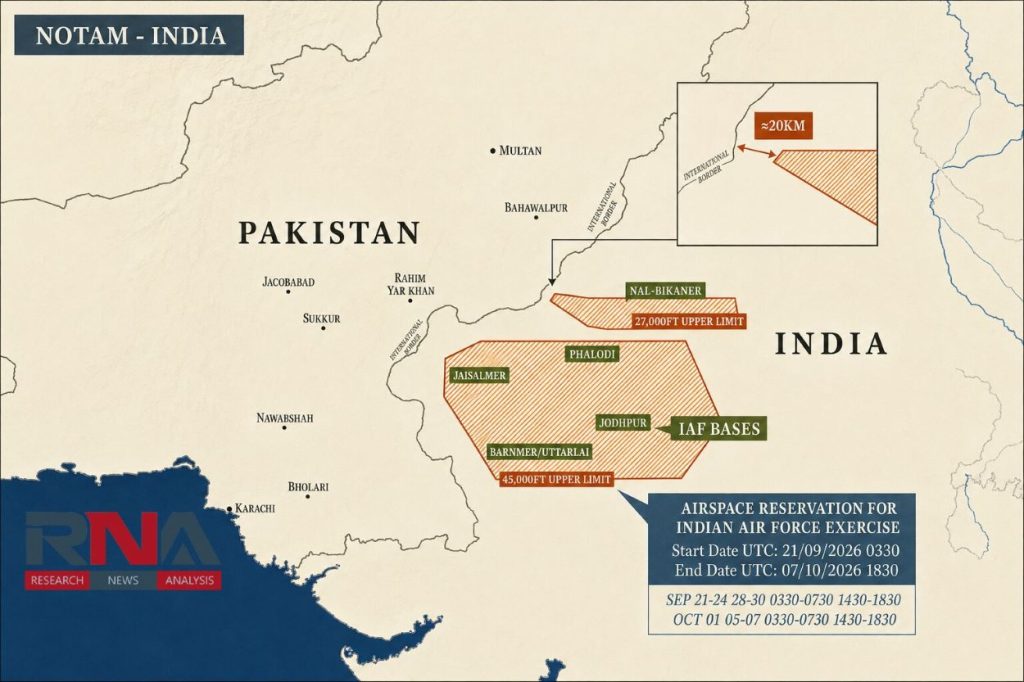
New Delhi: The Indian Air Force is set to run two major air exercises over the Rajasthan sector in the coming month, and a fresh notice to air missions (Notam) has reserved vast stretches of desert airspace for high-intensity flying through most of this period. The overlapping drills – a bilateral exercise with Japan and a large multinational exercise – will keep the skies over the western border busy well into October 2026.
According to the Notam, the airspace has been reserved from September 21 to October 7, a window of 17 days, covering the Jaisalmer–Barmer–Phalodi–Jodhpur sector besides the area around Nal, near Bikaner. The reservation, listed under sector codes T-1 and T-2 in aviation-tracking feeds, extends up to roughly 40,000 feet, with one of the designated zones reportedly coming within about 20 kilometres of the international border with Pakistan.
A Notam is a routine aviation advisory. It alerts pilots, airlines and air-traffic authorities to temporary restrictions or hazards over a stretch of airspace and does not by itself reveal the exact nature or scale of the activity being conducted within it.
Exercise Veer Guardian 2026
The first of the two exercises, Veer Guardian 2026, runs from September 9 to September 21 at Jodhpur Air Force Station and the surrounding airspace. It marks the first time Japanese fighter jets will operate from Indian soil, with the Japan Air Self-Defence Force sending three F-2A fighters and around 110 personnel from the Eighth Air Wing, based at Tsuiki in Fukuoka prefecture.
The ferry itself is no small undertaking. The JASDF jets are routed to Jodhpur via Naha Air Base in Okinawa and a stopover in Thailand, with the United States Air Force providing air-to-air refuelling support along the way, while the overall deployment window – including transit both ways – spans September 1 to September 30.
Veer Guardian is a young exercise but an important one on the India-Japan defence calendar. Its first edition, Veer Guardian 23, was held in Japan from January 16 to January 26, 2023, at the Hyakuri and Iruma airbases. The Air Force had sent four Sukhoi Su-30MKI fighters, two C-17 transport aircraft and an Il-78 refueller with about 150 personnel, while the JASDF fielded four F-2 and four F-15 fighters in return.
This year, the direction has reversed. It is Japan’s turn to fly into India, and its F-2s – a larger derivative of the American F-16 – are expected to fly dissimilar air-combat training sorties against the Air Force’s Su-30MKIs, giving each side useful exposure to aircraft broadly comparable to what China and Pakistan respectively operate.
Exercise Tarang Shakti 2026
The second and larger of the two exercises, Tarang Shakti 2026, is scheduled from September 26 to October 12 at the Jodhpur airbase, overlapping with the tail end of the Notam period. It will be the second edition of what the Air Force describes as its biggest multinational air exercise, and reports suggest around eight countries are lined up to take part with aircraft, with roughly 30 more expected as observers.
The nations reportedly sending aircraft include the United States, France, Australia, Germany, the United Arab Emirates, Greece, Sri Lanka and Bangladesh. There has also been speculation, not yet officially confirmed, that American F-35 stealth fighters could take part, which would be the type’s first appearance at an exercise on Indian soil.
The inaugural Tarang Shakti, held in 2024, showed how far this outreach has already come. It was staged in two phases: the first at Sulur, in Tamil Nadu, from August 6 to August 14, with France, Germany, Spain and the United Kingdom flying in their aircraft, and the second at Jodhpur from August 29 to September 14, drawing Australia, Bangladesh, Greece, Singapore, the United Arab Emirates, the United States and Japan.
Close to 150 aircraft took part across both phases, with 70 to 80 deployed at a time. The defence minister, Rajnath Singh, visited Jodhpur during the second phase and watched a display involving the Prachand attack helicopter, the Sarang and Suryakiran aerobatic teams and the Tejas LCA, calling the exercise a platform to build cooperation and trust among friendly nations.
The timing of this year’s drills is not without context. They follow the Air Force’s Vayu Shakti firepower demonstration at the Pokhran Field Firing Range in February 2026, held in the presence of the president, Droupadi Murmu, where fighters including the Sukhoi-30, Jaguar and Mirage 2000 flew simulated strikes replicating the kind of missions carried out during Operation Sindoor.
Rajasthan’s western sector has, since Operation Sindoor, become a familiar stage for the Air Force to test and showcase its readiness close to the Pakistan border. Reports suggest the latest Notam has drawn attention within Pakistan’s defence establishment, with officials there said to be reviewing the notification, though there has been no official word from Islamabad on the matter.
Taken together, Veer Guardian 2026 and Tarang Shakti 2026 will keep Jodhpur and its surrounding desert airspace engaged for the better part of five weeks, bridging a bilateral fighter exercise with Japan and a multinational gathering drawing air forces from several continents. For the Indian Air Force, the back-to-back drills offer a chance to sharpen interoperability with a widening circle of partners, even as the Notam signals just how much flying activity Rajasthan’s skies should expect in the weeks ahead.