


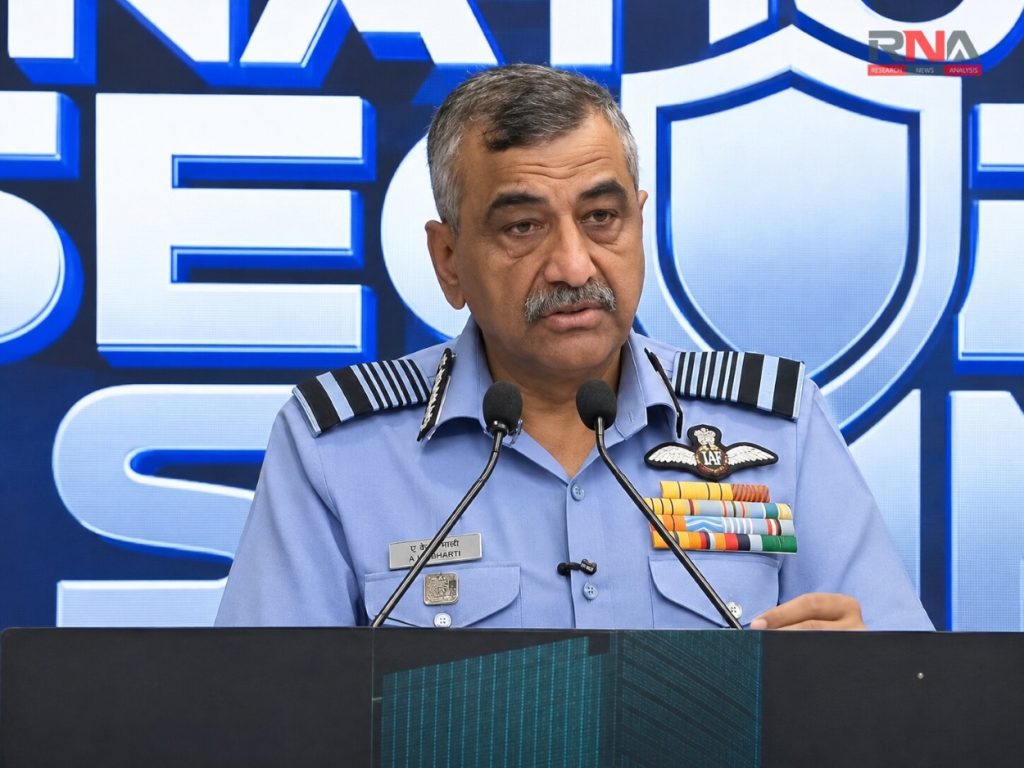
New Delhi: The Indian Air Force has the operational plans and capabilities needed to deter Chinese military aggression, but the challenge remains formidable as India confronts an expanding regional airpower imbalance, the chief of the air staff, Air Chief Marshal Ashutosh Dixit, said on Monday. His assessment comes as the IAF struggles with a shortage of fighter squadrons, delays in new aircraft deliveries and the growing urgency of modernizing its combat fleet to meet threats along India’s northern borders.
Speaking at the ANI National Security Summit 3.0 in New Delhi, ACM Dixit said the IAF was maintaining continuous surveillance of potential adversaries and adapting its operational plans to changes in their military capabilities. Responding to a question about India’s ability to counter China in terms of technology and numerical strength, he described the country’s deterrence position as manageable, although considerably more complicated than a straightforward comparison of combat aircraft might suggest.
“Our plans are in place. We are inducting new technology,” ACM Dixit said, adding that India was in an “okay situation” to deter aggression, even if the task was “not simple”. He emphasized that the effectiveness of an air force depended not merely on the number or sophistication of its aircraft but also on aircrew training, network-centric warfare capabilities and the operational environment in which those aircraft were deployed.
The air chief characterized the prevailing security environment as one of “no peace, no war”, in which military forces must remain prepared for a sudden transition from routine surveillance to active combat operations. He said the IAF had prepared for both offensive and defensive contingencies, underlining the importance of maintaining readiness even when tensions along the disputed frontier were not escalating into open hostilities.
Fighter shortage complicates India’s deterrence
ACM Dixit’s remarks draw attention to one of the IAF’s most persistent operational problems, which is a shrinking fighter fleet at a time when China’s People’s Liberation Army – Air Force (PLA-AF) is expanding its technological capabilities and modernizing its combat formations. The IAF currently has approximately 29 fighter squadrons against an authorized strength of 42.5, leaving a shortfall of 13.5 squadrons that cannot be addressed quickly through existing procurement programmes.
The numerical deficit does not automatically translate into a corresponding disadvantage in every operational scenario, particularly in the Himalayan theatre, where geography, airfield elevations, aircraft payload restrictions and logistical support influence combat effectiveness. Nevertheless, sustained operations across two potential fronts – China in the north and Pakistan in the west – demand sufficient aircraft, trained personnel, weapons reserves and supporting infrastructure to maintain sortie generation and replace combat losses.
The challenge is particularly significant because China has invested heavily in advanced fighters, airborne surveillance, electronic warfare and integrated air-defence networks, making air combat increasingly dependent on the ability to detect, identify and engage adversaries before they can respond. For India, improving connectivity between fighters, ground-based radars, airborne early-warning aircraft and long-range missile systems is therefore as important as increasing the number of aircraft in service.
Tejas-Mk1A and Rafale acquisitions critical
ACM Dixit said accelerating the induction of indigenously manufactured combat aircraft was essential to reversing the decline in squadron strength and improving the IAF’s operational flexibility. In a significant announcement at the same summit, he expressed confidence that the Air Force would receive its first squadron of Tejas-Mk1A fighters during the current financial year, which ends on March 31, 2027.
The assurance follows repeated delays in the indigenous fighter programme, caused by engine availability and the need to complete systems integration and flight trials. As RNA Media reported in September, ACM Dixit, who was the vice-chief of the air staff then, had said that the aircraft was approaching induction after engine-related bottlenecks were addressed, although some technical issues still required validation.
The IAF chief also called for faster progress on the proposed multirole fighter aircraft (MRFA) acquisition, warning that further reductions in squadron numbers were possible before replacement aircraft entered service. India is considering the procurement of 114 additional Rafale fighters from France, with the reported acquisition framework involving an estimated ₹3.25 lakh crore expenditure and substantial domestic manufacturing, although the proposed contract has yet to be finalized.
Under the arrangement being discussed, an initial batch of 18 aircraft could be supplied directly from France, with the remaining fighters manufactured in India through an industrial partnership involving Dassault Aviation. The proposed production rate of around 12 aircraft annually would make the programme a long-term contributor to India’s combat strength rather than an immediate solution to the IAF’s numerical deficit.
Su-30 modernization and AMCA programme
The IAF is also pursuing upgrades to its existing fleet, particularly the Su-30MKI, which remains the backbone of India’s air-combat capability. ACM Dixit indicated that plans to modernize the aircraft were advancing, with improvements expected to extend their operational relevance against increasingly sophisticated threats.
Another development on Monday concerned India’s AMCA (advanced medium combat aircraft), the proposed indigenous fifth-generation stealth fighter intended to address the country’s longer-term technological requirements. The defence secretary, Rajesh Kumar Singh, announced that three shortlisted bidders had submitted proposals and that the government expected to select the programme’s development partner within a month, potentially accelerating prototype development.
Dixit also indicated that the Tejas-Mk2, a larger and more capable successor to the existing light combat aircraft, could be rolled out in 2027. However, both the Tejas-Mk2 and AMCA will require extensive testing before operational induction, meaning neither can resolve the IAF’s immediate fighter shortage.
China border infrastructure adds another dimension
Beyond combat aircraft procurement, India’s efforts to improve its operational position along the line of actual control (LAC) include upgrading forward airfields and strengthening high-altitude logistics. On November 7, the IAF demonstrated an important capability when an Il-76MD heavy transport aircraft landed at Nyoma in eastern Ladakh, at an altitude of 13,629 feet, in what the service described as the highest landing ever achieved by the aircraft type, as RNA Media reported.
Such infrastructure improvements strengthen India’s ability to reinforce forward deployments and sustain military operations in difficult terrain, where conventional road transport faces geographical and seasonal limitations. They also illustrate why deterrence along the Chinese frontier cannot be measured solely by fighter squadron strength, even though the widening gap between authorized and available aircraft remains a serious concern.
The political context is equally important, with India and China continuing to manage their disputed boundary following the military confrontation that began in eastern Ladakh in 2020. Although diplomatic and military engagement has helped stabilize parts of the frontier, New Delhi maintains that lasting peace along the border is essential to rebuilding trust and normalizing bilateral relations.
For the IAF, ACM Dixit’s assessment therefore reflects two distinct realities – confidence in its present ability to respond to aggression and concern over the time required to build a larger, technologically stronger combat fleet. The immediate test will be whether indigenous aircraft deliveries, foreign acquisitions and upgrades to existing fighters can advance quickly enough to prevent the squadron deficit from becoming an increasingly serious operational constraint.