


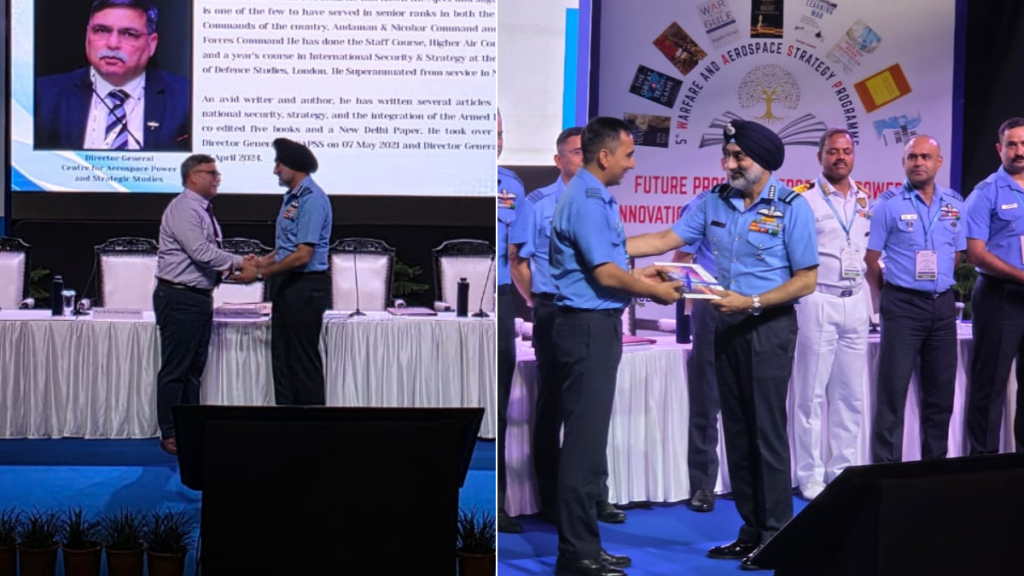
New Delhi: The Indian Air Force’s Warfare & Aerospace Strategy Programme (WASP) concluded its fifth edition with a Capstone Seminar, where participants presented research and policy proposals on future warfare. The chief of air staff, Air Chief Marshal Amar Preet Singh,2 attended the event as the chief guest.
Organized jointly by the Centre for Aerospace Power and Strategic Studies (CAPSS), New Delhi, and the College of Air Warfare (CAW), Hyderabad, the seminar marked the culmination of the programme’s six-month strategic studies course. The event also saw the participation of the former CDS, General Anil Chauhan (retired), former chiefs of the air staff and distinguished veterans.
One of the key presentations proposed the establishment of a national aerospace battle innovation hub (NABH) under Air Headquarters. The academic study, prepared by a team of nine Air Force officers and one Navy officer, recommended creating a dedicated organization to design, test and validate force structures for multi-domain operations. According to the reports, the hub would bring together expertise from the air, land, sea, space, cyberspace and cognitive domains. It would also evaluate emerging technologies and eventually collaborate with the DRDO and the defence industry to support capability development.
During the discussion, Wing Commander Amit Khatri clarified that the proposal was developed as an academic model to support future multi-domain operations. He said aerospace power is well suited to drive innovation in force design as military operations increasingly require coordination across multiple domains. Answering a question on the role of air power, Khatri said the outcome of any conflict depends on its political objectives and military goals. Wing Commander Medhavi Chandra added that while every domain contributes to military operations, no modern war can be won without air power.
The seminar featured presentations on two themes: “evolution of aerospace power: from classical strategy to contemporary limited conflict” and “future-proofing aerospace power: innovation, integration and force design.” Launched by the Air Force in 2022 under its professional military education initiative, WASP is a selective programme for mid-ranking Air Force officers and is also open to personnel from the Army, Navy and civilians from the defence ministry.
The programme combines extensive reading, strategic studies and interactions with experts to foster strategic thinking on national security and prepare future military leaders for emerging security challenges.
Addressing the participants, ACM AP Singh congratulated the graduates on completing the programme and encouraged them to continue pursuing knowledge throughout their careers while contributing to India’s strategic thinking ecosystem. The seminar also witnessed the release of the inaugural WASP-CAW Journal.