


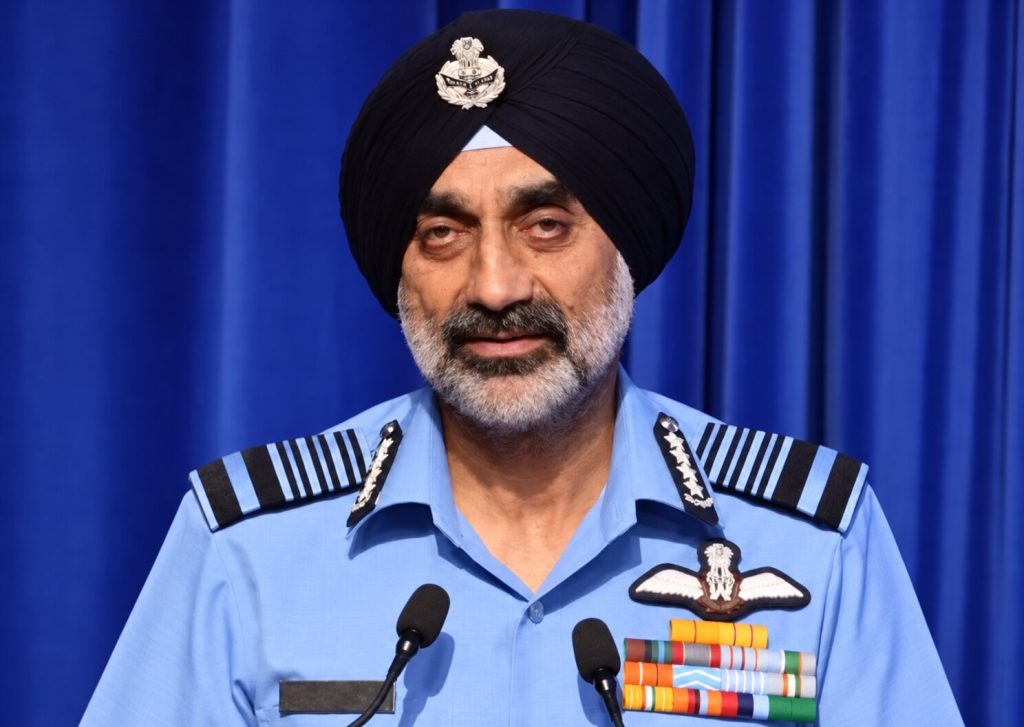
New Delhi: The chief of the air staff, Air Chief Marshal Amar Preet Singh, has called for faster modernization of the Indian Air Force, saying improvements in its capabilities must be accompanied by quicker inductions and greater combat strength. Speaking on Wednesday, ahead of the force’s 94th anniversary, he said the direction of progress was sound, but its pace needed to improve.
Addressing serving personnel and veterans at the Air Force Auditorium in Subroto Park, ACM Singh identified areas requiring “greater capacity, faster induction and more combat mass”. His anniversary-eve address acknowledged advances across the force while flagging delays, including in the Tejas-Mk1A programme.
Singh said the IAF had increasingly shifted towards developing integrated capabilities, with individual aircraft and weapons functioning as parts of a wider operational system. He credited this approach with demonstrating its effectiveness during Operation Sindoor, while stressing the need to strengthen capabilities as technology evolves.
The practical significance of that integration extends beyond the performance of any particular fighter aircraft. According to the defence ministry’s account of coordination during Operation Sindoor, the IAF’s Integrated Air Command and Control System worked alongside the Army’s Akashteer and the Navy’s Trigun to provide a shared operational picture, support timely decisions and reduce the risk of friendly fire.
The urgency behind ACM Singh’s appeal was clearer in his annual news conference on October 3 when he outlined the scale of the fighter shortage. The IAF had 29 fighter squadrons against a sanctioned strength of 42.5, and needed to induct approximately 36 to 40 fighter aircraft annually merely to arrest the continuing decline.
Tejas-Mk1A deliveries are therefore central to rebuilding the force’s strength, alongside other aircraft acquisitions and development programmes. The scale of that commitment is reflected in the defence ministry’s September 2025 contract with Hindustan Aeronautics Limited for 97 aircraft, comprising 68 fighters and 29 twin-seaters, with associated equipment, at a cost exceeding ₹62,370 crore excluding taxes.
At the October 3 briefing, ACM Singh supported indigenous development but questioned whether too many simultaneous programmes were competing for limited engineering resources and institutional capacity. He called for clearer priorities and more predictable delivery schedules, warning that delays were affecting the force’s capabilities.
The IAF’s plans span the Tejas-Mk1A, the more advanced Tejas-Mk2, the multi-role fighter aircraft acquisition and the indigenous AMCA (advanced medium combat aircraft). ACM Singh said these programmes would help address existing and emerging gaps but acknowledged that some would take time to become operational and that a mix of aircraft was necessary to meet the force’s requirements.
He also said the IAF would have to examine alternative aircraft if the AMCA programme suffered delays, while making clear that no particular platform had been selected. Separately, the air chief described Pakistan’s reported plans to acquire Chinese J-35 stealth fighters as a concern, although he maintained that India possessed capabilities to respond to the challenge.
The modernization agenda will soon pass to a new chief, with the government having appointed Air Marshal Ashutosh Dixit as ACM Singh’s successor, as RNA Media had reported. AM Dixit, currently the vice-chief of the air staff, will take over in the rank of air chief marshal on the afternoon of October 31 when ACM Singh retires.