


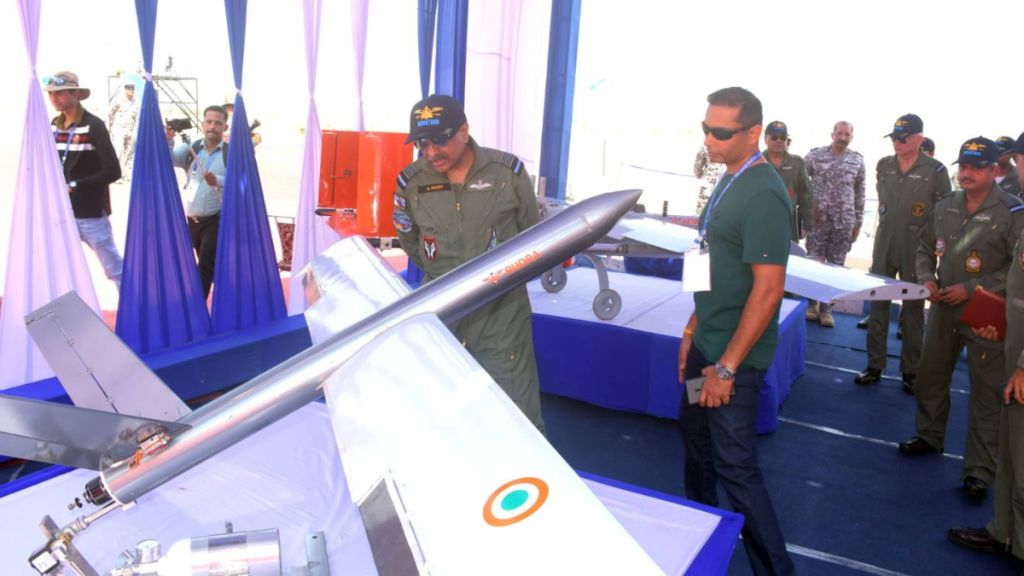
New Delhi: India’s first-ever Indian Air Force Dronathon has entered its second day at the Pokhran Field Firing Range in Jaisalmer, with drones and other unmanned technologies being tested in conditions designed to reflect real operational challenges. More than 20 defence companies, startups, MSMEs, DPSUs and innovators are taking part in the three-day event, which runs from September 14 to 16.
The IAF is using the exercise to see how emerging unmanned systems perform outside controlled demonstrations. The trials cover surveillance and reconnaissance, autonomous operations, drone swarms, electronic warfare and counter-unmanned aircraft systems (CUAS), giving the force a broader picture of how these technologies could be used in future operations.
The main focus of Dronathon-2026 is to determine whether new technologies can deliver a practical operational advantage. It assesses the reliability and effectiveness of systems in demanding and contested environments and their capacity to adapt to changing operational requirements and new threats.
The exercise also underscores the IAF’s increasing emphasis on use of unmanned systems alongside manned aircraft. Drones can give commanders additional options for surveillance, reach, persistence and flexibility during air operations, particularly in situations where sending manned aircraft may not always be the best option.
One of the key demonstrations on the opening day was Vayu UTtaM, the IAF’s indigenously developed multi-mode unmanned traffic management (UTM) system. During a live demonstration at Pokhran, the system detected and tracked both military and civilian unmanned aircraft in real time.
The system is designed to help manage drone operations as the number of unmanned aircraft in Indian airspace grows. It can also assist in identifying and dealing with unauthorized or rogue drones, making the technology relevant not only for military operations but also for airspace safety, critical infrastructure, civil aviation and public safety.
The IAF has also released its UAS Roadmap, setting out its priorities for future unmanned capabilities. The roadmap is expected to give Indian industry a clearer understanding of the technologies and capabilities the Air Force wants to develop.
This could help defence companies, startups, universities and research organizations focus their work on areas that match the IAF’s future requirements, instead of developing systems without a clear operational application.
Dronathon-2026 is not limited to testing complete drone platforms. The IAF is also looking at the wider technology chain needed to make unmanned systems useful in combat and other operational environments.
This includes propulsion, sensors and payloads, communications, autonomous systems, electronic warfare, countermeasures and airspace management. The approach is aimed at building an indigenous unmanned ecosystem rather than depending only on individual drone platforms.
As the first-ever IAF Dronathon continues at Pokhran, the emphasis is shifting from simply showcasing new technology to finding systems that can work reliably when operational conditions become more difficult. The trials are expected to help the IAF identify capability gaps and assess which technologies can eventually move from demonstrations to operational use.