


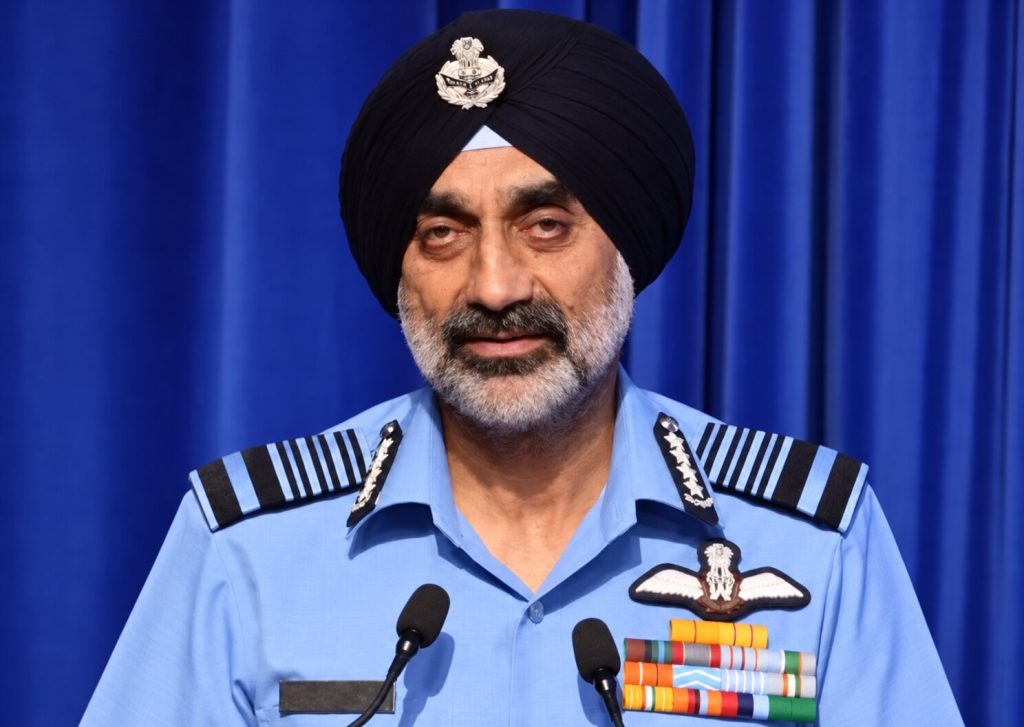
New Delhi: The Indian Air Force must anticipate changes in warfare instead of waiting to adapt after new threats emerge, Air Chief Marshal Amar Preet Singh, said on Friday. Speaking at a seminar in New Delhi, the air chief linked future battlefield success to recognizing technological shifts early and preparing the force to respond effectively.
The remarks came at the “Central Role of Air Power in the Evolving Battlespace” seminar at Subroto Park, held alongside the multinational Exercise Tarang Shakti 2026 underway in Jodhpur. ACM Singh said current global conflicts and India’s experience during Operation Sindoor in May 2025 had reinforced the importance of air power.
“Victory smiles upon those who anticipate changes in the character of warfare,” ACM Singh said, echoing a longstanding principle of air-power theory. Waiting for changes to occur before responding could leave a force too late to adapt, he cautioned.
For the IAF, that challenge extends beyond acquiring aircraft. Network centric operations depend on connecting sensors, aircraft, weapons and command systems, while multi-domain operations require coordination with capabilities in space, cyber and other military environments.
At the 94th Air Force Day celebrations at Hindan on Thursday, ACM Singh highlighted operational readiness and the speed with which the IAF entered combat operations during Operation Sindoor. He also emphasized integrating artificial intelligence and autonomous technologies while retaining human authority over their use.
Faster induction, greater combat capacity
In a separate address on Wednesday, ACM said the IAF needed “greater capacity, faster induction and more combat mass”. He acknowledged delays in the light combat aircraft (LCA) Mk1A programme and emphasized the shift from a platform-centric to a capability-centric approach.
At his October 3 press conference, ACM said the IAF needed 36 to 40 new fighters annually to arrest its declining fleet strength. The force has around 29 fighter squadrons against an authorized 42.5, while Mk1A deliveries remain delayed, as RNA Media reported earlier.
The IAF is looking towards the Tejas-Mk1A, its planned Mk2 variant and future combat aircraft programmes to address the shortfall. Their contribution will depend on production and timely induction rather than procurement plans alone.
Drones within an integrated combat force
Unmanned systems are another part of that approach. At the October 3 briefing, ACM Singh described drones as “evolutionary” rather than revolutionary for the IAF and opposed creating a separate drone force, favouring their integration with fighters, air defence and other weapons, as RNA Media reported earlier.
The IAF’s modernization priorities extend beyond aircraft acquisition to space enabled capabilities, communications, electronic warfare and coordination with the Army and Navy. ACM Singh’s remarks underline the importance of aligning technology development, military training, operational doctrine and domestic defence production with the changing demands of warfare.