


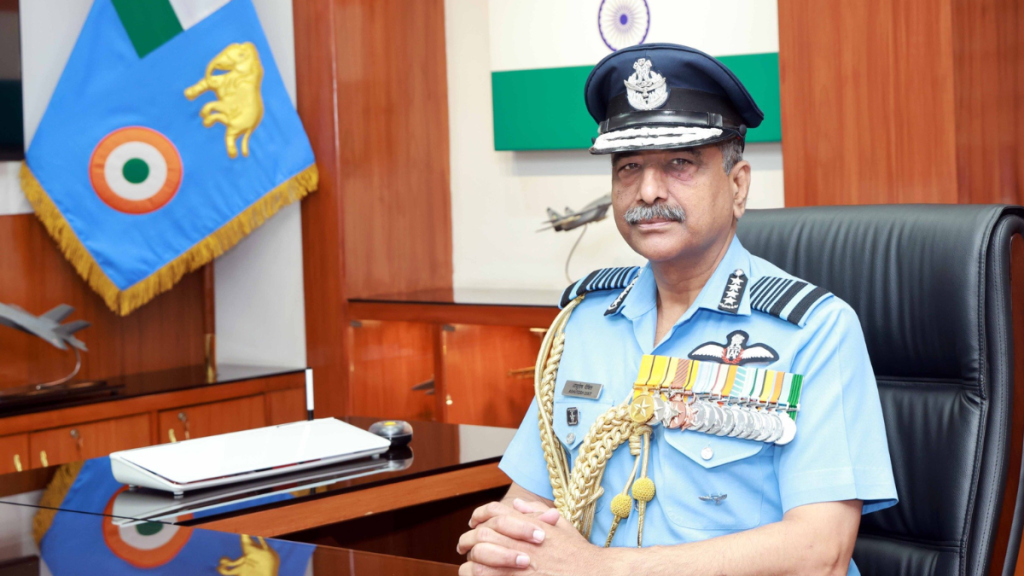
New Delhi: The chief of air staff, Air Chief Marshal Ashutosh Dixit, on Sunday marked his priorities for the Indian Air Force – a day after taking charge as the country’s 29th chief of the air staff. In his first public address after assuming the post, he introduced the “Vayu” vision, focusing on combat readiness, indigenous defence capabilities, technological innovation and joint operations.
Addressing personnel during a guard of honour ceremony at Air Force Station, ACM Dixit said the IAF’s priorities could be summed up in four areas represented by the word Vayu. He also identified restoring the force’s combat strength to its sanctioned level as one of his foremost tasks.
What Is Vayu?
ACM Dixit said V stands for Vigilance and Readiness, which means every squadron, radar, air defence unit and Air Warrior must be prepared to respond at short notice. He stressed that rebuilding the IAF’s combat strength was a key priority.
A stands for Atmanirbharta, (self-reliance). He identified the Tejas-Mk1A and Mk2, advanced medium combat aircraft (AMCA), Indian-made sensors and weapons as major priorities. He said the force must have these capabilities in sufficient numbers to meet its operational and maintenance requirements.
Dixit added that India’s air power should not only be capable of fighting and winning wars but also strong enough to deter conflicts.
Y stands for Yukti, referring to innovation in technology, procedures and military planning. He highlighted the need for AI-enabled command and control systems, layered counter drone defences, responsive maintenance and stronger force protection.
He also pointed to resilience and the use of near-space as areas that would receive attention as the IAF develops its future operational capabilities.
U stands for Unity of Effort, linking this priority to the Jai vision of Jointness, Atmanirbharta and Innovation, ACM Dixit said the IAF would work closely with the Army, Navy and national agencies. He stressed that air power delivers the best results when it is integrated into military planning from the beginning.
New technologies changing nature of warfare
The new Air Chief also highlighted how emerging technologies are changing the nature of warfare. He pointed to the growing role of drones, long-range precision weapons, space, cyber capabilities, artificial intelligence and the electromagnetic spectrum.
He said India’s security environment remained demanding and that the IAF needed to adapt to these developments. At the same time, the force must remain prepared to fight and win while transforming into the air force India would need over the next decade.
ACM Dixit succeeded 28th ACM Amar Preet Singh, who retired after 42 years of service. As earlier reported by RNA Media, ACM Dixit was commissioned into the IAF’s fighter stream in December 1986 and has held several key operational and command positions during his nearly four-decade career. He also served as vice-chief of the air staff before taking charge as the 29th air chief.