


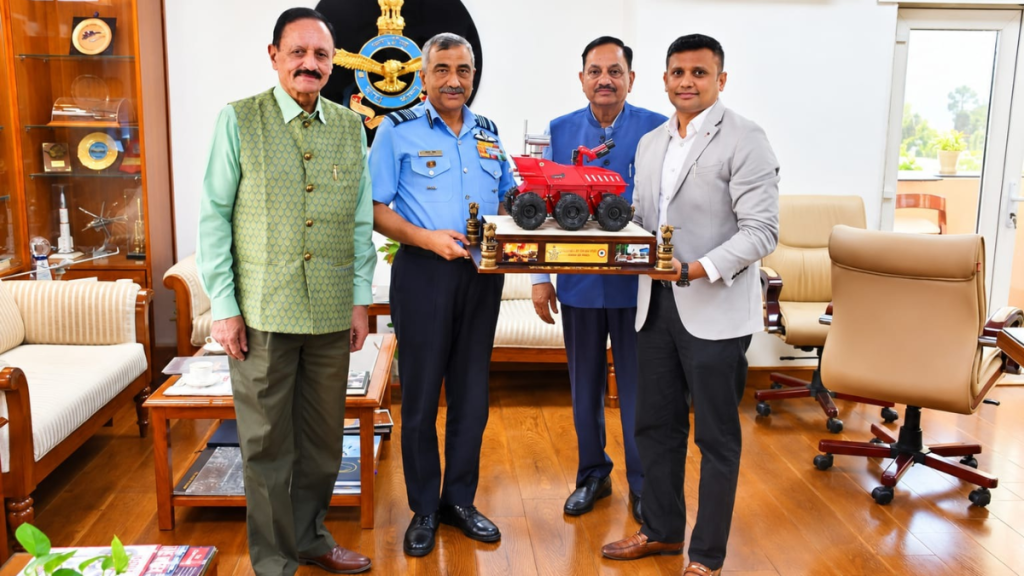
New Delhi: When a missile or drone hits an air base, the first half-hour decides whether fighter squadrons can launch again. In that window, one Made in India machine is built to go where human crews cannot: the FF Bot, a firefighting robot from Swadeshi Empresa Private Limited, a Ministry of Defence-backed startup. The company is notable for being the first iDEX Sprint case winner under the Defence India Start-up Challenge 7 (DISC 7).
The Indian Air Force placed an emergency procurement order with Swadeshi Empresa. It was large, strategically important and had a 12-month delivery schedule. The Ahmedabad-based company completed it in 11 months. For an iDEX-first, Ministry of Defence-backed startup, this is a strong example of what Indian industry can deliver.
The FF Bot is certified by the Directorate General of Quality Assurance (DGQA), confirming that it meets the quality standards required for defence supply.
Innovation backed by execution
Swadeshi Empresa is India’s indigenous firefighting robotics company. It began under the Ministry of Defence’s Innovations for Defence Excellence (iDEX) framework and built its technology through in-house R&D. What sets it apart is not only innovation but also delivery. Every major order has been completed on time or ahead of schedule, and the company serves the Indian Army, Indian Navy and Indian Air Force.
Operation Sindoor and the need for the FF Bot
The need for this capability moved from theory to live combat during Operation Sindoor in May 2025. On the night of May 7 to 8, Pakistan attempted to strike 15 Indian locations with drones and missiles. The targets included key air stations and military installations such as Adampur, Bhuj, Uttarlai, Phalodi, Nal, Bathinda, Awantipura, Srinagar, Jammu, Pathankot, Amritsar, Kapurthala, Jalandhar, Ludhiana and Chandigarh. The Air Force’s integrated counter-drone grid and wider air defence networks intercepted the incoming salvos.
The threat grew over the next day. Addressing the Lok Sabha on July 29, 2025, the prime minister, Narendra Modi, said that on May 9 Pakistan launched about 1,000 missiles and drones towards Indian territory, and that every one was destroyed mid-air. Days later, the prime minister visited Adampur air base to counter Pakistani claims that it had been destroyed.
Yet a perfect interception record in one battle raises a question for the next: what happens on the tarmac if a single warhead or burning drone debris gets through? A hit on a fuel farm, liquid oxygen bay or munitions revetment can set off secondary fires and a “cook-off”, where fire detonates nearby ammunition. Crash fire tenders cannot safely approach in that situation.
How the FF Bot works
The FF Bot closes that gap. It is operated from outside the hazard radius using a touchscreen and joystick console. Built on a stainless-steel, six-wheel-drive chassis with a 360-degree turning radius, it rolls into compromised zones where crews cannot go. Its thermal and optical cameras see through dense smoke and stream live feeds to the command post, while a self-cooling system lets it withstand radiant heat. Foam and fog-water monitors suppress fuel fires and cool munitions casings, and a heavy-duty winch drags hoses over rubble and tows vehicles or equipment weighing up to 5 tonnes out of the fire lane. Once the robot contains the fire, human explosive ordnance disposal teams and rapid runway repair squads move in to get the base operational again.
Proven in the field
These robots are not prototypes or demonstration systems. They are operationally deployed with India’s armed forces and have proved their effectiveness in live fire incidents. On February 27, 2026, the Air Force demonstrated the FF Bot during Exercise Vayu Shakti 2026 at the Pokhran Field Firing Range. President Droupadi Murmu, the defence minister, Rajnath Singh, and the chief of the air staff, Air Chief Marshal AP Singh, watched the robot navigate simulated debris and suppress live fires while its operators stayed outside the blast radius. Earlier Air Force trials reportedly saw it clear every base-level firefighting benchmark with margin to spare.
Air defence grids showed in May 2025 that they can intercept 1,000 incoming drones and missiles. The Air Force is prepared for immediate rescue missions from day one, using the FF Bot as part of the solution. From indigenous R&D to early delivery and field deployment, the journey of Swadeshi Empresa shows how an iDEX-first, Ministry of Defence-backed startup can build and deliver mission-critical technology for the nation’s forces.