


New Delhi: As India ramps up its unmanned aerial vehicle (UAV) arsenal, the Ministry of Defence has received nearly 10 bids for its procurement of 87 medium-altitude long-endurance (MALE) UAVs for the Indian Air Force.
The bidders are from both the public and private sectors, and the project is worth over ₹30,000 crores, according to media reports.
Among the firms that have reached out to the ministry are Hindustan Aeronautics Ltd, Solar Defence and Aerospace Ltd, Tata Advanced Systems Ltd, Larsen and Toubro, and Raphe mPhibr Ltd. The defence ministry had given its formal assent for the procurement of 87 MALE drones in August last year. The procurement of this nature aligns with India’s vision of a future-ready military.
The heavy investment in drones comes as they have become a decisive factor in modern warfare. This was amply evident during Operation Sindoor last year, when the Indian Army and Air force used armed drones and loitering munitions to carry out precision strikes on terror launchpads inside Pakistan.
The forces also used the counter-UAS (unmanned aerial systems) technology and integrated grids to intercept and neutralize hundreds of Pakistani drones entering Indian territory.
The Indian Air Force, under a separate project, is also looking to develop fixed-wing “kamikaze” drones, having the ability to fly at 16,000 feet. According to the reports, the IAF will retain the intellectual property rights to carry out future upgrades and customisation. Among IAF’s other requirements, the drone must be able to carry a payload of at least 30kg while supporting interchangeable payloads, including weapons, sensors and airborne data relay systems, required at the time of carrying of specific missions.
The Indian defence forces, together, are said to go in for a purchase of $2 billion worth of drones, as RNA Media had reported earlier. The president of the Drone Federation of India, Smit Shah, was quoted by Reuters as saying that in the next phase, tactical drone procurements in India may exceed ₹200 billion or more than $2 billion.
The new orders are likely to follow a fast-track procurement route designed to meet urgent operational needs. On the modern battlefield, drones have acted as a highly cost-effective tool to carry out surveillance as well as precision strikes.
During the 2020 Nagorno-Karabakh Conflict, Azerbaijan launched a major offensive using drones. It achieved a decisive air and technological superiority by utilizing a mix of Turkish-made and Israeli-made UAVs.
The Russia-Ukraine war has witnessed a sustained and escalating use of drones by both sides, with UAVs playing a pivotal role in surveillance, precision strikes, and deep-penetration attacks on critical infrastructure. Similarly, during this year’s US-Iran war, drones have acted as a key instrument of military signalling and targeted operations.
Defence ministry receives nearly 10 bids for 87 MALE drones to bolster Indian Air Force’s UAV capabilities
Among the firms that have reached out to the ministry are Hindustan Aeronautics Ltd, Solar Defence and Aerospace Ltd, Tata Advanced Systems Ltd, Larsen and Toubro, and Raphe mPhibr Ltd. The defence ministry had given its formal assent for the procurement of 87 MALE drones in August last year. The procurement of this nature aligns with India’s vision of a future-ready military.
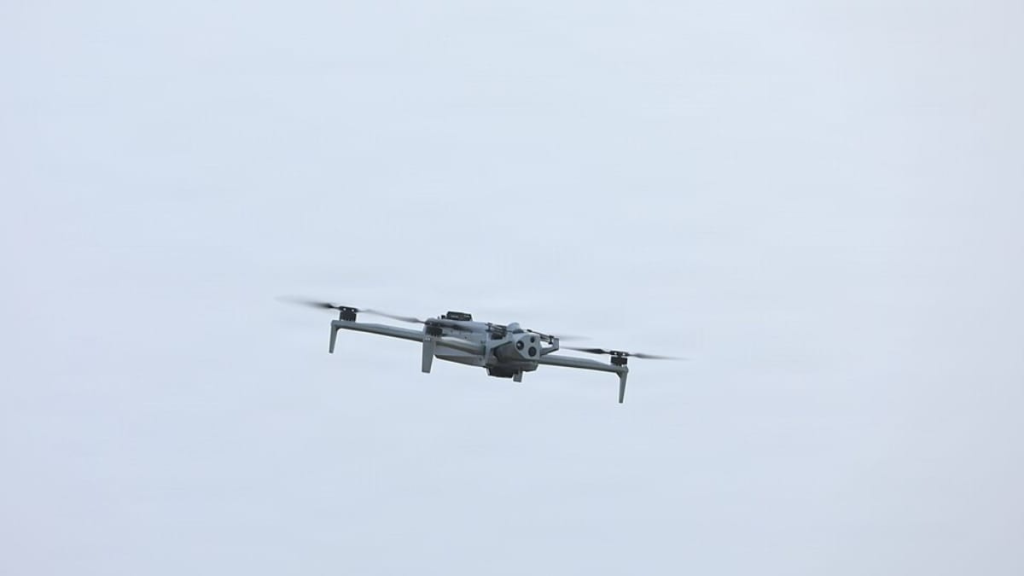
Representational Image. Image Courtesy: Wikimedia Commons