


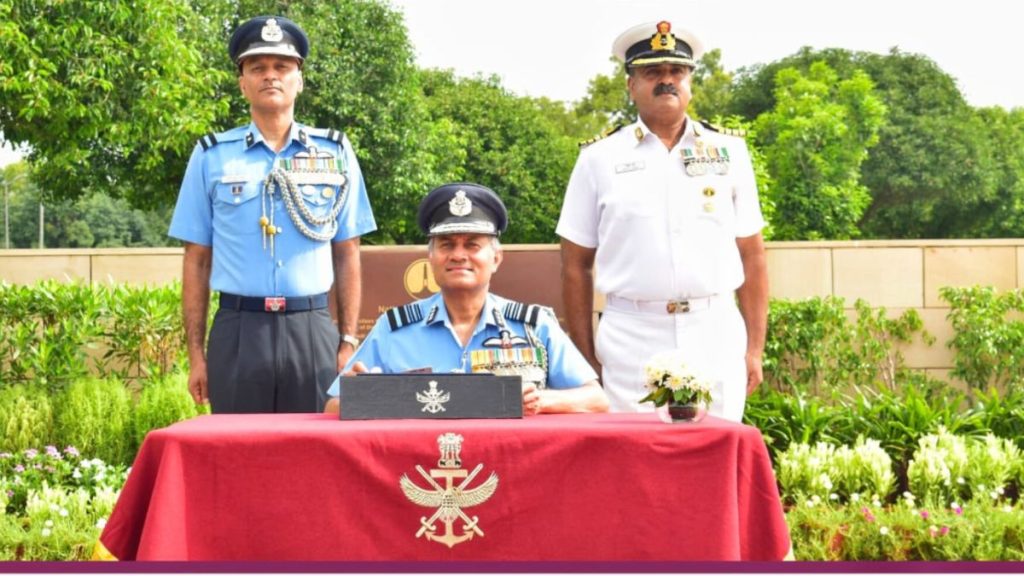
New Delhi: Air Marshal Awadhesh Kumar Bharti, who served as the Indian Air Force’s director general air operations (DGAO) during Operation Sindoor last year, superannuated on Friday after nearly four decades of service. He retired from the post of deputy chief of air staff (DCAS), a position he moved into after the operation, and marked his final day by laying a wreath at the National War Memorial in New Delhi.
The National War Memorial, in a post on X, said AM Bharti paid homage to fallen soldiers in a wreath-laying ceremony on his superannuation.
The face of Operation Sindoor
AM Bharti’s name became widely known in May 2025, when he was one of three officers who fronted the armed forces’ press briefings during Operation Sindoor. He appeared alongside Lieutenant General Rajiv Ghai, then director general military operations (DGMO), and the Navy’s director general of naval operations (DGNO), Vice Admiral AN Pramod.
The operation was launched on May 7, 2025, in response to the terror attack in Pahalgam on April 22 that killed 26 civilians. As DGAO, AM Bharti was responsible for planning and coordinating the IAF’s part of the response, which began with strikes on nine terrorist infrastructure sites in Pakistan and Pakistan-occupied Kashmir.
When Pakistan retaliated, the IAF struck back. Between May 8 and 10, Indian jets hit 11 Pakistani airbases, including Nur Khan (Chaklala), Sargodha, Rafiqui, Murid, Sukkur, Chunian, Bholari and Jacobabad, according to the details Air Marshal Bharti laid out at the press briefings that week. The hostilities ended on May 10, after the DGMOs from both sides spoke over a hotline.
The line that went viral
At a briefing on May 11, 2025, a reporter pressed AM Bharti on whether India had lost a Rafale jet during the conflict. His reply became one of the most widely quoted lines to come out of the operation.
“We are in a combat situation and losses are part of combat. The question you must ask is: have we achieved our objectives of decimating the terrorist camps? The answer is a thumping yes, and the results are for the whole world to see,” AM Bharti said.
He was equally direct when asked about casualties on the Pakistani side. “How many casualties? How many injuries? Our aim was not to inflict casualties, but in case there have been… our job is to hit the target, not to count body bags,” he said, before confirming that all Indian pilots involved in the operation had returned home safely.
From Purnia to the cockpit
AM Bharti was born in Jhunni Kalan village in Bihar’s Purnia district and is the eldest of four siblings. His father, Jiwachh Lal Yadav, worked at the Kosi Irrigation Project, and his mother, Urmila Devi, raised the family in Kosi Colony, close to Purnia town.
His brother, Dr Rajesh Kumar Bharti, has said their grandfather wanted to see him fly and would recite stories from the Ramayana and Mahabharata to instil a sense of duty and heritage in him.
AM Bharti studied at Purnia Convent School and Adarsh Madhya Vidyalaya before moving to Sainik School, Tilaiya. He then joined the National Defence Academy in Pune, where he topped his course and won the Sword of Honour, one of the institution’s highest distinctions.
A career built on flying hours and command
AM Bharti was commissioned into the Indian Air Force’s fighter stream on June 13, 1987. He went on to qualify as a fighter combat leader and completed postgraduate courses at the Defence Services Staff College and the National Defence College.
He commanded the No. 24 and No. 30 Squadrons, and led a Su-30MKI squadron from 2005 to 2007, during which he helped bring the aircraft’s weapon systems into full operational use. His squadron took part in major exercises, including Gagan Shakti, and joint drills with the British and French air forces.
Over his career, AM Bharti has logged more than 5,000 hours of flying time. He has received the Vayu Sena Medal, the Ati Vishisht Seva Medal and the Sarvottam Yudh Seva Medal, along with a Chief of Air Staff commendation in 1997 and three stars for accident-free flying.
He took over as DGAO on October 1, 2024, and moved to the post of deputy chief of air staff on June 1, 2025, shortly after Operation Sindoor. Air Marshal George Thomas succeeded him as DGAO.