


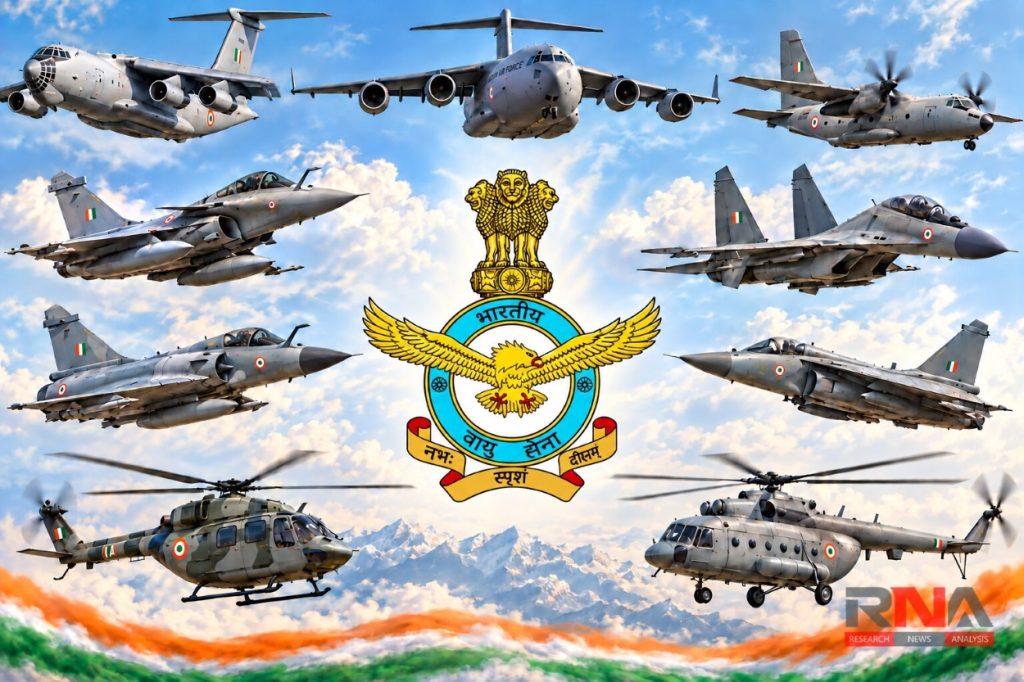
Today is the 94th Indian Air Force Day, marking the anniversary of a service established on October 8, 1932, whose first operational flight followed on April 1, 1933, with four Westland Wapiti biplanes, six officers and 19 air soldiers. From that modest beginning under colonial rule, the Indian Air Force (IAF) grew into a force entrusted with defending independent India’s skies, supporting its soldiers and reaching people whom war or disaster had cut off from help.
The anniversary offers an opportunity to look beyond the aircraft in ceremonial formations and remember the decisions, risks and sacrifices that gave the service its character. There are countless achievements worth recalling across its history, but these five moments from the years since Independence stand out for their consequences, ingenuity and courage – four wartime operations that helped shape India’s security and one humanitarian mission that brought thousands of people home.
Srinagar, 1947: The airlift that helped hold Kashmir valley
On October 27, 1947, the immediate task facing India was to get soldiers into Srinagar before advancing Pakistan-backed tribal forces could close the opportunity. Jammu & Kashmir’s accession to India had opened the way for military assistance, but a decision in Delhi would mean little unless troops reached the threatened valley in time.
Dakota transports of the then Royal Indian Air Force carried soldiers of 1 Sikh into Srinagar, beginning an air bridge that would sustain the defence of the valley. Civilian aircraft and crews also joined the effort, adding urgently needed capacity to a military transport fleet stretched by the demands of Partition.
The soldiers were entering a rapidly changing battlefield, with little time to settle, assess their surroundings or prepare elaborate defensive arrangements. Under their commanding officer, Lieutenant Colonel Dewan Ranjit Rai, they moved to confront the approaching raiders; Rai was killed during the opening fighting, an early reminder of the price of holding the line.
For the aircrews, the first landings were only the beginning of an obligation that could not be discharged in a single dramatic flight. Reinforcements and supplies had to keep arriving, because every soldier delivered to Srinagar depended on a continuing connection with the rest of India.
The operation’s importance lies in that combination of urgency and endurance: the aircraft brought an immediate fighting force into the valley, then helped make its continued resistance possible. A transport aircraft approaching an airfield might appear less spectacular than a fighter attacking an enemy position, yet here its arrival carried consequences that extended far beyond the runway.
Srinagar’s defence was a joint achievement, involving the soldiers who fought, the aircrews who delivered them and the civilian aviators who answered the emergency. The Air Force’s particular contribution was to give India something it desperately needed in those opening hours – the ability to act before events on the ground overtook its decisions.
Meghna, 1971: The heli-bridge that opened the way to Dhaka
In December 1971, the Meghna presented Indian forces advancing through East Pakistan with a formidable obstacle, strengthened by Pakistani defensive positions around the crossing. A destroyed bridge threatened to slow an offensive whose success depended heavily on maintaining momentum towards Dhaka.
The commander of IV Corps, Lieutenant General Sagat Singh, saw an opportunity to bypass the obstacle by moving troops across the river in helicopters. Working with Group Captain Chandan Singh and IAF crews, he helped turn an audacious proposition into a succession of flights beginning on December 9, 1971.
Mi-4 helicopters carried soldiers and equipment to landing areas beyond the river, allowing the Army to bypass Pakistani defences around Ashuganj. The crossing shifted the practical question from how to force a defended passage to how quickly Indian troops could assemble on the other side and continue towards Dhaka.
The simplicity of the idea concealed the difficulty of carrying it out, particularly as flying continued into darkness. Crews had to find landing areas, handle repeated troop movements and keep aircraft serviceable, while the soldiers stepping out of the helicopters had to organize themselves for the next stage of the advance.
A participating pilot, Squadron Leader Pushp Kumar Vaid, later recalled the night flying and the sustained movement of troops and supplies during the eastern campaign. His account brings the achievement down from the language of grand strategy to its working parts: flight planning, loading, maintenance and another departure when the previous sortie was barely over.
The heli-bridge did not by itself win the war, but it helped prevent a major geographical barrier from dictating the pace of the Indian offensive. Its lasting distinction is that the Air Force gave a bold ground commander the means to exploit an opportunity that conventional movement could not readily provide.
For soldiers waiting to cross, the approaching helicopters represented a route forward when the bridge ahead had been destroyed. For the campaign, they supplied something equally valuable – time, preserved through imagination and disciplined execution.
Longewala, 1971: When the Hunters arrived at first light
During the night of December 4–5, 1971, Pakistani armour and infantry advanced against the isolated Indian position at Longewala in Rajasthan. Major Kuldeep Singh Chandpuri and his soldiers of 23 Punjab held the post, facing a force whose tanks gave it a substantial advantage over the defenders.
The darkness imposed its own limit on the help available from the air, leaving the soldiers to resist until daylight made effective fighter attacks possible. At first light, IAF Hunters from Jaisalmer arrived over the battlefield and began attacking the Pakistani tanks and vehicles.
Their intervention changed the battle’s direction, striking an armoured force that had advanced without adequate air protection. Successive attacks damaged and destroyed vehicles, disrupted movement and reduced the enemy’s ability to press its assault against the post.
The pilots’ accuracy mattered, but so did the work that allowed them to return repeatedly to the fighting. At Jaisalmer, ground crews serviced, refuelled and rearmed the Hunters with urgency, making aircraft availability an essential part of the battle rather than a routine matter behind it.
For the defenders, the aircraft’s arrival meant that the balance of firepower was finally changing. Their overnight resistance had kept the position intact long enough for the Air Force to act, and the air attacks gave that resistance a decisive effect.
Flying continued against the withdrawing Pakistani force, extending the disruption beyond the immediate perimeter of Longewala. The account of Jaisalmer’s wartime base commander, later Air Marshal M.S. Bawa, records both the repeated attacks and the appreciation sent by the Army for the support its soldiers received.
Longewala remains memorable because the relationship between the two services was so direct and consequential. Soldiers held their ground through the night; pilots and ground crews then helped ensure that the enemy could not turn its numerical advantage into a breakthrough.
Its emotional force needs little embellishment: men who had endured hours under threat saw friendly aircraft arrive when they were most needed. Few episodes illustrate more clearly what timely air support can mean to those fighting below.
Kargil, 1999: Learning to strike where the mountains concealed the enemy
When the IAF began Operation Safed Sagar on May 26, 1999, it entered a battlefield that challenged familiar assumptions about the use of air power. Pakistani troops occupied high mountain positions, while India’s political direction required its aircraft to conduct attacks without crossing the Line of Control.
The targets were often small, concealed and difficult to distinguish from the surrounding rock and snow. Altitude affected aircraft and weapon performance, while the threat from portable surface-to-air missiles made low-level attacks particularly hazardous.
Early aircraft losses brought those dangers into sharp focus and forced the Air Force to reassess how it fought. The response required revised attack methods, careful reconnaissance and the effective use of Mirage 2000 fighters and targeting equipment.
The attack on the Pakistani supply camp at Muntho Dhalo struck at the resources sustaining troops on the heights. Precision attacks in the Tiger Hill area also hit important positions, showing how carefully chosen targets could influence the fighting beyond the immediate point of impact.
The effect accumulated through shortages, disrupted command arrangements and increasing pressure on the defenders, whose exposed supply system was crucial to their continued resistance. Army units still had to climb, assault and recover the occupied positions, but the Air Force helped weaken the enemy they encountered.
Kargil’s distinction lies partly in that willingness to adapt while combat was already under way. Crews and planners had to recognize what was failing, change their methods and keep operating within restrictions intended to contain the conflict.
For the soldiers advancing uphill, the value of an air attack was measured in the resistance that remained when they reached their objective. For the pilots, success depended on identifying and striking positions that could be almost invisible against the mountains.
Safed Sagar deserves remembrance as an achievement of courage informed by learning. The Air Force encountered a punishing environment, paid for early setbacks and developed ways to make its contribution increasingly effective.
Uttarakhand, 2013: Flying back for those still waiting
In June 2013, floods and landslides devastated Uttarakhand, severing roads and leaving pilgrims, residents and tourists stranded in mountain valleys. At places around Kedarnath, people endured days without adequate food, water or any certainty about when help would reach them.
The IAF launched Operation Rahat, deploying helicopters and transport aircraft for rescue, reconnaissance and the movement of supplies and response teams. The Army, disaster-response forces and other agencies worked alongside it, confronting a disaster whose destruction repeatedly obstructed access to those in need.
The flying demanded close attention to weather, terrain and the limits of each aircraft. Narrow valleys, drifting cloud and poor visibility could delay a mission just when the people waiting below were becoming more vulnerable.
Across the operation, published tallies record 3,536 sorties, 23,892 people evacuated and approximately 798 tonnes of relief material delivered. Those figures convey the scale, but each evacuation also marked an individual passage from isolation towards shelter, treatment or reunion with family.
On June 25, 2013, a Mi-17 V5 crashed during the rescue effort, killing personnel aboard, including five members of the Air Force. The IAF crew, led by Wing Commander Darryl Castelino, had repeatedly flown lifesaving missions in the Kedarnath valley before the fatal flight.
The loss brought grief into an operation already surrounded by human suffering, but the rescue effort continued. Aircraft returned to the valleys because people were still stranded and the need that had sent the crews there remained urgent.
Rahat belongs among the Air Force’s finest moments for the same qualities that distinguish its wartime achievements: difficult decisions, skilled execution and persistence under pressure. Here, those qualities were directed towards people whose immediate hope rested on an aircraft reaching them.
For someone cut off by a washed-away road, the sound of a helicopter could mark the end of days of uncertainty. That promise of help – made real through repeated flights and carried at terrible cost by some crews – gives Operation Rahat its enduring place in the service’s history.
Behind these five moments stand countless air warriors whose courage, skill and devotion to duty have shaped the Indian Air Force, including those who gave their lives in battle or while bringing others to safety. On its 94th anniversary, we honour those who never returned, remember the families who carry their loss and salute the generations whose service has made the IAF a guardian of the nation and a source of hope in its darkest hours.